


Diagnosing a Premature Furnace Breakdown Before the First Cold Snap
The Startling Reality of an Early Fall Furnace Lockout
You turn up the thermostat to shake off the evening chill, expecting a rush of warm air, but instead, you find yourself diagnosing a premature furnace breakdown before the first cold snap even fully arrives. The system clicks, the fan might hum briefly, and then everything goes silent. When a heating system fails on the very first chilly night of the September pre-heating season, the immediate reaction is often panic. Homeowners naturally assume the worst: a burned-out motor, a cracked heat exchanger, or a complete system failure that will require a massive, unexpected investment.
Here is the thing: in our experience at Top Shelf Heating and Air, many early-season "breakdowns" we respond to in Moorpark are not mechanical failures at all. Instead, they are built-in safety mechanisms functioning exactly as they were designed to. The transition from summer dormancy to active heating exposes hidden vulnerabilities within the system. After months of inactivity, a furnace accumulates elements that can trick its internal computers into shutting down to protect your home from a potential gas leak. Distinguishing between a minor sensor issue and a catastrophic failure requires a professional evaluation. By investing in professional heating services and securing a comprehensive preventative maintenance plan, you can ensure your system is accurately diagnosed and safely prepared for the winter months ahead.
• The clicking sound: A rhythmic clicking that stops after a few seconds is a classic sign of an ignition failure, not necessarily a dead blower motor.
• The short cycle: If the furnace fires up for less than ten seconds and immediately shuts down, a safety sensor is likely intervening.
• The unresponsive thermostat: When the screen is blank or the system ignores commands entirely, the control board may have locked itself out after repeated failed attempts.
How Summer Dormancy Creates Hidden Hazards for Heating Equipment
To understand why furnaces struggle in the early fall, you have to look at what happens during the summer. While your air conditioner is running, your furnace cabinet sits idle. During this extended period of inactivity, microscopic household dust, pet dander, and airborne particulates settle inside the dormant heating equipment. Our technicians consistently notice that Moorpark's extended mild autumns cause furnaces to sit idle even longer than in other regions, allowing significantly more time for this dust accumulation to build up before the sudden winter nighttime temperature drops force the system into action.
This seemingly harmless dust becomes a highly effective insulating barrier on the furnace's most sensitive internal components. At Top Shelf Heating and Air, we see the impact of heavy dust accumulation year-round. In one recent Moorpark service call, our team visited a homeowner who was convinced their air conditioning system was completely irreparable. Our thorough diagnostic revealed that the blower motor was simply heavily coated in dust and suffocating. After our technicians performed a deep professional clean, the system ran strong again. The exact same principle applies to your furnace during the September pre-heating season.
The Vulnerability of High-Efficiency Systems
Older furnaces relied on standing pilot lights and relatively simple mechanical gas valves. If the pilot was lit, the furnace ran. Modern high-efficiency systems, however, are essentially large, combustion-based computers. They are significantly more sensitive to environmental buildup than older, simpler models. A micro-layer of dust that an old furnace would simply burn off can completely blind the sensors of a modern unit.
When heavy dust accumulation coats the flame sensor or clogs the pressure switch tubing, the control board interprets this as a critical failure. It cannot distinguish between a sensor that is slightly dirty and a sensor that is completely broken. Therefore, it defaults to the safest possible action: shutting the entire system down. This is why a simple layer of summer dust can easily mimic severe mechanical failures, leaving homeowners shivering and frustrated.
The Mechanics of a Modern Furnace Safety Lockout
A modern furnace with an electronic flame sensor operates on a strict sequence of events. If any step in this sequence fails to report back correctly, the system aborts the startup. The flame sensor is arguably the most critical component in this chain. It is a thin metal rod positioned directly in the path of the gas burner. Its sole job is to detect the presence of a safe, active fire through a process called flame rectification.
When the flame touches the sensor rod, an alternating current (AC) is sent to the rod, and the flame itself acts as a conductor, converting it into a tiny direct current (DC) measured in microamps. If the control board does not receive this specific microamp signal, it assumes the gas is flowing without igniting, which would cause raw gas to pool dangerously in your home. A lockout is a successful safety intervention preventing this hazard, not a mechanical failure.
The Ignition Sequence Explained
1. The Call for Heat: The thermostat sends a signal to the furnace control board. The draft inducer motor starts immediately to clear lingering gases from the heat exchanger.
2. Proving the Draft: A pressure switch verifies that the inducer motor is actually moving air safely out of the exhaust flue.
3. Ignition and Gas Flow: The hot surface igniter glows bright orange (or a spark igniter begins clicking), and the gas valve opens to release fuel into the burners.
4. Active Monitoring: The flame sensor actively monitors the burners for successful combustion.
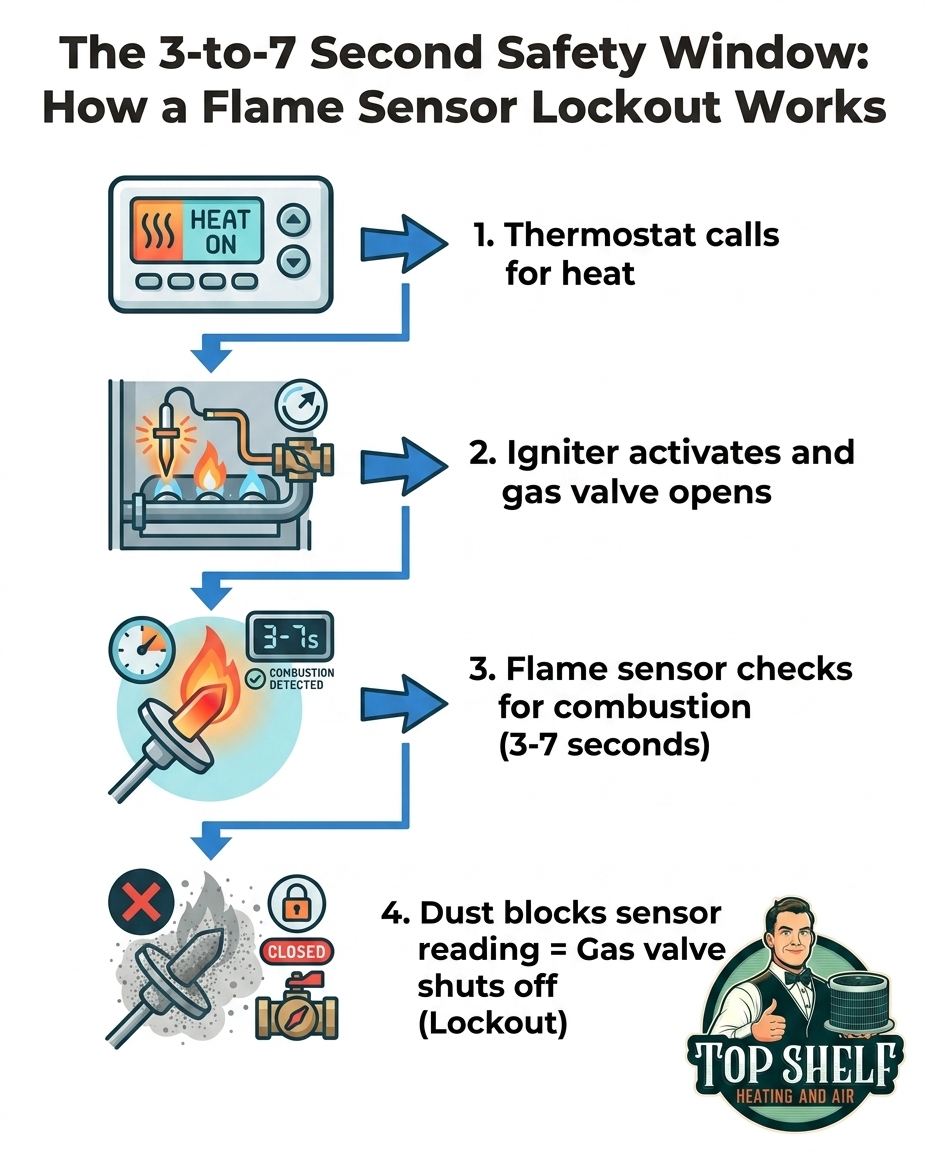
The 3-to-7 Second Safety Window
1. The Critical Window: Once the gas valve opens, the control board gives the flame sensor exactly 3 to 7 seconds to detect a flame.
2. The Insulating Barrier: If the sensor is insulated by dormant summer dust, it fails to detect the microamp current of the flame, even if the fire is actually burning perfectly.
3. The Immediate Shutdown: The control board immediately cuts the gas supply to prevent a hazard, extinguishing the flame.
4. The Hard Lockout: After three or four failed attempts, the system enters a "hard lockout" and refuses to try again until power is manually reset.
Differentiating Between a False Alarm and a True Premature Breakdown
Understanding how a modern furnace with an electronic flame sensor operates helps you distinguish between a simple sensor lockout and a genuine, catastrophic mechanical failure. When you are standing in front of a cold vent, the symptoms can feel identical, but the sounds and behaviors of the furnace cabinet tell a very different story.
Just last fall, our Top Shelf Heating and Air team helped a local Moorpark family who faced a situation where their furnace stopped working right before the first cold week of winter. With young children in the house, the situation was urgent. Our professional diagnostic revealed it was a genuine failed part rather than a simple sensor lockout. Our technician diagnosed the issue, ordered the specific component, and installed it by the next day, getting the system back up and running efficiently for the cold week. This highlights the urgency of accurate diagnostics right before winter weather arrives in full force.
Repeatedly resetting your furnace by flipping the breaker on and off is highly discouraged. If the system is in a hard lockout, resetting it forces it to try lighting again. If the root cause is a dirty sensor, the furnace will just fail again. However, if the root cause is a failing draft inducer or a cracked heat exchanger, forcing the system to run can damage the control board or push carbon monoxide into the home.
• Startup Sounds — Likely a Sensor Lockout (False Alarm): Normal inducer hum, clicking igniter, brief whoosh of flame that stops immediately. — Likely a True Mechanical Breakdown: Loud grinding, metal-on-metal screeching, or absolute silence when the thermostat calls for heat.
• Burner Behavior — Likely a Sensor Lockout (False Alarm): Flames ignite cleanly for 3 to 7 seconds, then abruptly shut off. — Likely a True Mechanical Breakdown: Flames roll backward out of the cabinet, burn yellow/orange, or fail to ignite entirely.
• Odors — Likely a Sensor Lockout (False Alarm): A brief, normal "dust burning" smell on the very first cycle of the year. — Likely a True Mechanical Breakdown: Persistent electrical burning smells, melting plastic, or strong raw gas odors.
• Blower Fan — Likely a Sensor Lockout (False Alarm): May run continuously to cool the heat exchanger after a failed ignition attempt. — Likely a True Mechanical Breakdown: Fan motor hums loudly but refuses to spin, or vibrates violently.
Why Professional Intervention is Crucial for Sensitive Components
When a modern furnace with an electronic flame sensor shuts down due to dormant dust, the correct next step is to schedule a professional evaluation. The internet is full of DIY tutorials suggesting homeowners remove the flame sensor and scrub it with sandpaper, emery cloth, or steel wool. We strongly warn against these DIY attempts. The flame sensor is an incredibly delicate component, often featuring a metal rod encased in a fragile ceramic insulator.
Using abrasive materials on a flame sensor permanently ruins the component. Sandpaper leaves behind microscopic silica residue that turns into glass when exposed to the furnace flame, creating an even thicker insulating barrier. Furthermore, heavy abrasives create micro-scratches in the metal rod, which act as magnets for future dust accumulation, guaranteeing the furnace will lock out again in a matter of weeks.
The Professional Pre-Season Diagnostic
Drawing on our team's hands-on experience at Top Shelf Heating and Air, we have diagnosed countless real-world early-season lockout issues for Moorpark homeowners. This allows us to accurately identify false alarms without unnecessary upselling. When our professional technicians arrive, we approach a lockout systematically:
• Safe Cleaning: Our professionals use specialized, non-abrasive materials to safely clear dormant dust without scratching the sensor rod or leaving behind melting residues.
• Electrical Testing: Using a specialized multimeter, the technician tests the exact microamp draw of the sensor while the flame is burning to ensure it is communicating perfectly with the control board.
• Comprehensive Verification: A tune-up doesn't just clean the sensor; it verifies safe combustion, checks gas pressure, tests safety limit switches, and ensures the heat exchanger is intact.
Furthermore, professional handling preserves manufacturer warranties on newer units. Most major HVAC manufacturers explicitly state that damage caused by improper DIY maintenance voids the warranty on the control board and associated sensors.
Exploring Long-Term Upgrades When a Breakdown is Genuine
While a lockout on the first cold night is often a simple sensor issue, we must acknowledge that occasionally, early-season failures are genuine indicators that a system has reached the end of its lifespan. If our professional diagnostic during the September pre-heating season reveals a cracked heat exchanger, a seized blower motor, or a failing control board on a furnace that is over 15 years old, pouring money into repairs may not be the wisest investment.
When a breakdown is genuine, it becomes crucial to evaluate the entire system's efficiency and reliability. Older furnaces typically operate at much lower AFUE (Annual Fuel Utilization Efficiency) ratings, meaning a significant portion of the energy they consume is wasted as exhaust. Upgrading to a modern, high-efficiency system provides superior comfort, quieter operation, and vastly improved safety features.
To help offset the investment of a new, highly efficient system, homeowners should explore the availability of general energy incentives and federal tax credits. Many modern high-efficiency furnaces and heat pumps qualify for substantial utility rebates designed to encourage energy conservation. Because these programs change frequently and vary by municipality, we advise readers to consult with local experts to navigate available utility rebates effectively. Upgrading your home's comfort infrastructure is easier when you explore comprehensive HVAC system solutions and spend time finding HVAC rebates and energy incentives that apply to your specific installation.
Frequently Asked Questions About Early-Season Furnace Lockouts
Why did my furnace lock out on the first cold day?
Your furnace likely locked out because summer dust accumulation on the flame sensor prevents it from detecting ignition, triggering a safety shutdown. During the months your heating system sits idle, microscopic dust settles inside the cabinet. When you turn the system on for the first time, this dust acts as an insulator, stopping the electronic sensors from reading the flame and causing the control board to abort the startup to keep your home safe.
Can dust cause a furnace to stop working completely?
Yes, even microscopic dust layers can insulate electronic sensors, causing the control board to cut gas flow as a safety precaution. A modern furnace with an electronic flame sensor relies on precise microamp readings to verify combustion. If dust blocks this reading, the furnace will enter a hard lockout and refuse to run entirely until the sensor is professionally cleaned and the system is reset.
What does a furnace flame sensor do?
It detects the presence of a flame to ensure gas is actively burning; if no flame is detected, it shuts off the gas valve to prevent dangerous accumulation. The sensor sits directly in the path of the burner. When the gas ignites, the flame conducts a tiny electrical current through the sensor back to the control board, proving that it is safe to keep the gas flowing.
How do you fix a furnace that clicks but won't ignite?
A professional must diagnose the ignition sequence, clean or replace the flame sensor, and verify proper gas flow. Because the clicking indicates the system is trying to start but failing a safety check, DIY repairs are dangerous and can void your warranty. An expert will use specialized tools to clean the delicate components and test the microamp draw without damaging the unit.
Is a furnace lockout dangerous?
The lockout itself is a safety feature designed to prevent danger; however, bypassing it or repeatedly resetting the system can create hazards. The furnace shuts down specifically to prevent raw gas from pooling in your home or carbon monoxide from leaking. Constantly flipping the breaker to force the system to run ignores the underlying safety warning and can permanently damage the control board.
Securing Peace of Mind Before the First Cold Snap Arrives
When you find yourself diagnosing a premature furnace breakdown before the first cold snap, it is easy to assume the worst. However, it is vital to remember that a lockout on a modern system is often just the furnace protecting your home from unsafe ignition. The dormant dust that settles during the summer months is a natural occurrence, but it requires professional attention to resolve safely.
Proactive evaluation prevents sudden, stressful failures on the coldest nights of the year. By scheduling a professional inspection with Top Shelf Heating and Air during the September pre-heating season, our technicians can safely clear away dormant dust, test your flame sensors, and verify that your system is ready for the heavy lifting of winter. A clear, expert diagnosis provides the reassurance that your system's safety features are working exactly as they should, ensuring your home remains warm, safe, and comfortable all season long.
Customer Testimonials


Blogs