

Navigating HOA Noise Restrictions When Replacing Your Oak Park AC Unit
The Challenge of Upgrading Air Conditioning in Regulated Neighborhoods
Your outdoor condenser is failing, the house is sweltering, and you need a fast solution—but navigating HOA noise restrictions when replacing your Oak Park AC unit introduces a unique layer of complexity to the process. Replacing a failing condenser during peak-summer heat is stressful enough without worrying about whether your new equipment will trigger a neighborhood dispute or a formal violation notice. Homeowners in planned communities must carefully balance the immediate need for robust cooling capacity with strict community bylaws governing mechanical noise at the property line.
Selecting the right equipment from the start prevents costly installation delays, neighbor complaints, and potential architectural review committee (ARC) rejections. If you install a unit that exceeds the community's noise limits, you could be forced to modify the installation or even remove the equipment entirely. Understanding modern cooling technology is the first step to achieving compliance without sacrificing indoor comfort. Whether you are exploring new air conditioning systems or preparing for an immediate AC replacement in Oak Park, securing a unit that meets both your cooling demands and your neighborhood's acoustic standards is entirely possible with the right approach.
The Hidden Costs of Non-Compliance
Many Oak Park HOA communities enforce strict rules regarding exterior modifications and mechanical noise. Failing to account for these rules can lead to significant setbacks. If an unapproved unit is installed, the association may issue fines, mandate costly sound-dampening retrofits, or require the relocation of the condenser to a less optimal area of your yard. Proactive planning ensures a seamless transition to a cooler home without the bureaucratic headache.
Decoding Decibel (dB) Ratings for Residential Cooling
To successfully navigate community noise restrictions, it is essential to understand how sound is measured and evaluated by architectural review boards. Sound intensity is measured in decibels (dB), which operate on a logarithmic scale. This means that decibel levels do not increase linearly; even small numerical increases represent significant jumps in perceived loudness. For example, a 10 dB increase means the sound is ten times more intense and generally perceived by the human ear as twice as loud.
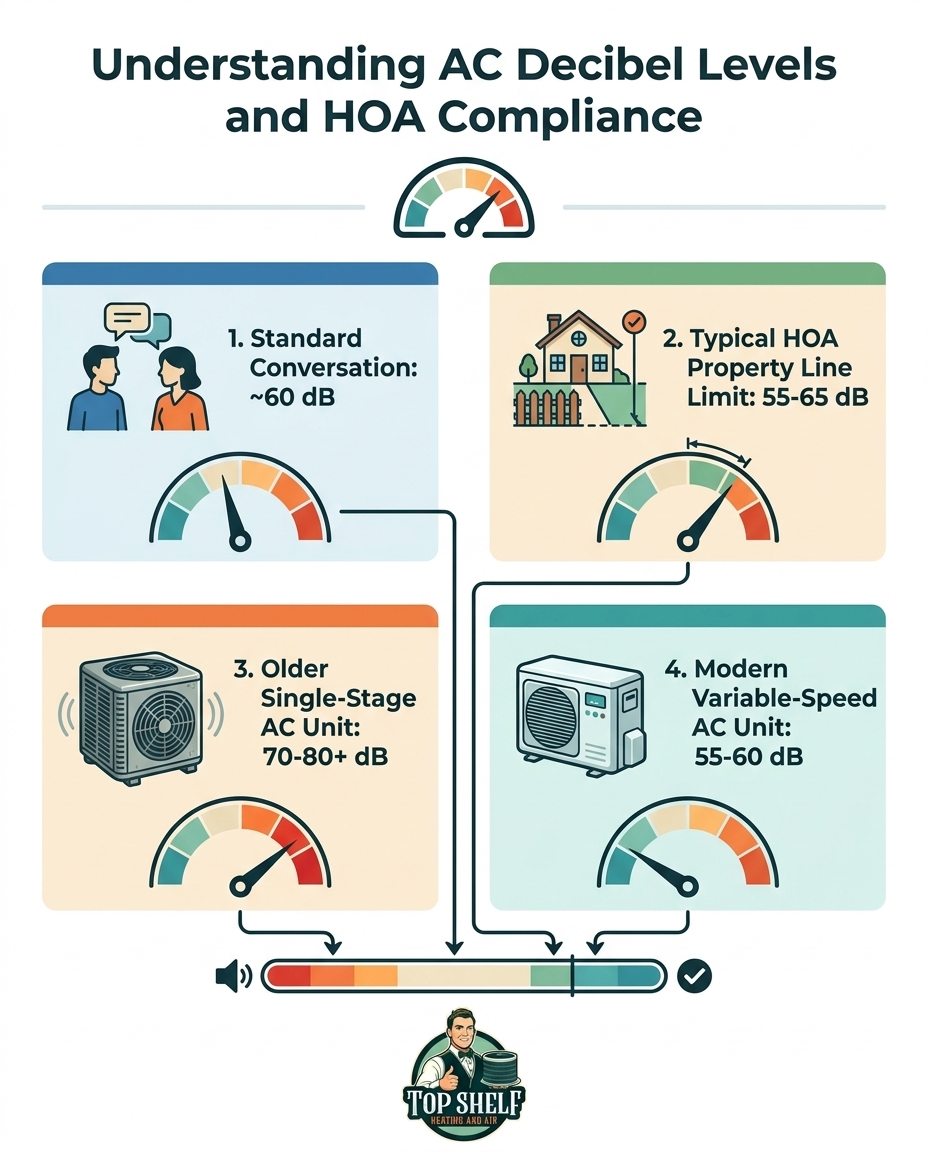
A standard indoor conversation registers around 60 dB, while older, single-stage outdoor condensers frequently operate at 70 to 80+ dB. When these older units cycle on, the sudden roar can easily disrupt a quiet evening outdoors. Many local municipal codes and homeowners associations cap continuous residential mechanical noise at 55 to 65 dB at the property line. Verifying the Air-Conditioning, Heating, and Refrigeration Institute (AHRI) sound rating of a new unit is a mandatory step for securing HOA approval.
Common Decibel (dB) Ratings Compared
• Rustling Leaves / Quiet Library — Estimated Decibel (dB) Level: 30 - 40 dB — Perceived Loudness: Faint
• Modern Variable-Speed AC Unit — Estimated Decibel (dB) Level: 55 - 60 dB — Perceived Loudness: Quiet / Background Hum
• Normal Conversation — Estimated Decibel (dB) Level: 60 - 65 dB — Perceived Loudness: Moderate
• Standard HOA Property Line Limit — Estimated Decibel (dB) Level: 55 - 65 dB — Perceived Loudness: Maximum Allowed Continuous Noise
• Older Single-Stage AC Unit — Estimated Decibel (dB) Level: 70 - 80+ dB — Perceived Loudness: Loud / Disruptive
• Lawnmower / Power Tools — Estimated Decibel (dB) Level: 90+ dB — Perceived Loudness: Very Loud
When selecting a new unit, the manufacturer's published decibel (dB) ratings provide the baseline data your HOA will require. However, it is crucial to remember that this factory rating is measured under ideal, open-air conditions. How the unit sounds once installed in your specific yard may differ based on the surrounding environment.
Why Tightly Spaced Homes Amplify Compressor Noise
Planned communities often feature zero-lot-line architectures or narrow side yards where condensers are traditionally installed. While this maximizes the usable space in your backyard, it creates a challenging acoustic environment for mechanical equipment. Close proximity to property lines and neighboring windows means sound waves bounce rapidly between hard stucco walls, amplifying the perceived noise level significantly.
This architectural layout creates a "canyon effect." Even if a condenser has a factory rating of 65 dB, the reverberation off adjacent exterior walls can make it sound much louder to a neighbor sitting on their patio just a few feet away. During periods of extended operation, this amplified noise is a primary trigger for neighbor complaints and subsequent HOA violation notices. Acoustic planning must account for these environmental factors, not just the unit's factory rating, to ensure true compliance.
With tightly spaced homes in Oak Park amplifying noise during hot Southern California summers when units must run continuously at maximum capacity, the margin for error is incredibly slim. In our experience providing Oak Park HVAC services, our team at Top Shelf Heating and Air finds that working with professionals who understand how to mitigate sound reflection in narrow residential spaces is vital. Proper placement, acoustic barriers, and selecting the right compressor technology are all critical steps we use to prevent noise amplification.
The Impact of Hardscaping on Sound
• Concrete pads: Standard concrete equipment pads can transmit low-frequency vibrations directly into the ground, which can be felt in adjacent rooms.
• Stucco siding: Hard, flat exterior walls reflect sound waves rather than absorbing them, increasing the volume in narrow side yards.
• Block walls: Masonry property dividers trap sound within the side yard, forcing the acoustic energy upward toward second-story bedroom windows.
How Variable-Speed Compressors Solve the Noise Dilemma
The technological leap from traditional single-stage compressors to modern variable-speed systems is the definitive solution for meeting strict community noise limits. Traditional single-stage compressors turn on at 100% capacity every time the thermostat calls for cooling. This creates a loud, disruptive "clunk" followed by a high-decibel hum that easily echoes across property lines and startles neighbors.
Variable-speed (inverter-driven) compressors, on the other hand, ramp up gradually. By starting at a low capacity—often as low as 25% or 30%—they eliminate the aggressive startup noise entirely. Once running, these advanced systems can maintain indoor temperatures by operating at lower, ultra-quiet speeds for longer cycles. Many variable-speed models operate consistently below 60 dB, blending seamlessly into the ambient background noise of the neighborhood.
Recently, our team at Top Shelf Heating and Air worked with a local homeowner whose failing 20-year-old HVAC system had become a significant neighborhood nuisance. After our technicians upgraded them to a modern variable-speed unit, the new system operated so quietly that the disruptive noise was completely eliminated, easily satisfying community standards. We highly recommend this technology because it delivers maximum cooling power when needed while remaining acoustically compliant during continuous operation, making it the ideal choice for any new AC installation in a regulated neighborhood.
Key Benefits of Inverter Technology
Beyond acoustic compliance, variable-speed compressors offer significant performance advantages during the hottest months of the year. By running continuously at lower capacities, they provide superior humidity control and eliminate the uncomfortable temperature swings associated with older on/off systems. They also draw less startup amperage, reducing stress on the electrical grid and lowering overall energy consumption under heavy loads.
Why Aging Air Conditioners Trigger Mid-Summer Scrutiny
Air conditioners do not age gracefully when it comes to acoustics. As mechanical components wear down over a 15-to-20-year lifespan, units naturally produce more vibration, rattling, and grinding noises. What was once a compliant, relatively quiet system can slowly become a neighborhood nuisance as internal parts degrade.
Failing fan motors, unbalanced fan blades, and deteriorating rubber compressor mounts can push a previously compliant unit well over the allowed decibel limit. During July peak summer heat, when systems run for hours on end to keep up with the thermal load, these mechanical flaws become glaringly obvious. Neighbors who might tolerate a brief rattle in the spring are far less forgiving when a failing compressor screams outside their window for twelve hours a day.
Emergency replacements during peak heat waves are highly scrutinized by HOAs. When a unit fails completely in mid-summer, we often see homeowners rush to install whatever equipment is immediately available, skipping the formal approval process. This routinely leads to compliance violations. Upgrading before a complete failure allows time to properly navigate the architectural review process and select a unit engineered for quiet operation.
Common Sources of Aging AC Noise
• Degraded isolator feet: The rubber pads that cushion the compressor rot away over time, causing metal-on-metal vibration.
• Worn fan motor bearings: Dry or failing bearings produce a high-pitched squeal or grinding sound that easily penetrates neighboring windows.
• Loose cabinet panels: Years of vibration can loosen the screws holding the exterior cabinet together, creating a loud, continuous rattle.
• Unbalanced fan blades: Dirt buildup or slight bending of the fan blades causes a rhythmic thumping noise.
Streamlining the HOA Approval Process for Your New Condenser
Securing approval for a new outdoor unit requires more than just submitting a basic request form. Most associations require a formal architectural request detailing the new unit's exact dimensions, placement, and AHRI sound rating. Providing comprehensive documentation upfront is the best way to prevent delays and ensure your family isn't left without cooling during the review process.
Providing a site plan that maps the distance from the condenser to the nearest property line demonstrates proactive compliance to the review board. When a board sees that you have accounted for property lines and selected equipment specifically designed to meet their decibel limits, the approval process moves much faster. Recently, another homeowner came to us overwhelmed by the options while transitioning to a new cooling setup, requiring a solution that balanced robust performance with whisper-quiet operation. By helping them select a Daikin FIT system and providing the proper documentation, our team secured a clean, professional installation that met all their cooling needs while running quietly enough to pass strict neighborhood scrutiny.
Partnering with a contractor who pre-selects ultra-quiet models tailored to local bylaws prevents application rejections. At Top Shelf Heating and Air, our deep knowledge of local Oak Park HOA compliance positions us as your local experts who streamline the approval process, ensuring you select equipment that meets both your comfort needs and community standards. Additionally, gathering documentation on energy efficiency can be beneficial, as federal tax credits or utility incentive programs may apply to qualifying high-efficiency installations. Exploring HVAC rebates and energy incentives with your utility provider or a tax professional can help offset the initial investment of a premium, variable-speed system.
Essential Documents for Your Architectural Review Committee
To expedite your approval, ensure your application package includes the following:
1. Manufacturer Specification Sheet: Highlighting the unit's dimensions and the official AHRI decibel rating.
2. Property Site Plan: A simple drawing showing the exact location of the new unit relative to property lines and neighboring structures.
3. Contractor License and Insurance: Proof that the installation will be performed by a licensed professional.
4. Acoustic Mitigation Plan: Details on any vibration pads or sound blankets being installed to further reduce noise.
Enhancing Acoustic Control for Maximum Cooling Power
Even if you select a highly rated, quiet condenser, the way it is installed plays a massive role in its final acoustic footprint. There are several installation techniques and accessories that can further reduce mechanical noise, ensuring absolute compliance and maintaining peace with your neighbors.
Installing heavy-duty vibration isolation pads beneath the unit prevents sound transfer into the concrete pad and surrounding soil. These thick, composite rubber and cork pads absorb the low-frequency humming that often travels through the ground and into adjacent homes. Additionally, compressor sound blankets can be added to certain models to muffle internal mechanical noise without restricting critical airflow. These heavy-duty acoustic wraps fit snugly over the internal compressor, significantly reducing the harsh mechanical sounds of the refrigerant cycle.
Strategic placement, such as shifting the footprint slightly away from a neighbor's bedroom window or angling the unit to direct sound waves toward an open space, can drastically improve acoustic relations. Finally, proper sizing ensures the system doesn't overwork. An oversized unit will short-cycle—turning on and off rapidly—which creates repeated, disruptive startup noises. A correctly sized system maintains a quieter, more consistent operational baseline.
Accessories That Make a Difference
• Acoustic Compressor Blankets: Designed by manufacturers to fit specific compressors, these wraps dampen high-frequency noise.
• Anti-Vibration Mounts: Specialized feet that isolate the unit from the concrete pad.
• Acoustic Fencing: (If permitted by the HOA) specialized barriers lined with sound-absorbing materials to block line-of-sight noise transmission.
Secure a Quiet, High-Performance Cooling Solution
Navigating community noise restrictions doesn't mean compromising on indoor comfort during the hottest months of the year. The technology exists to keep your home perfectly chilled without turning your backyard into a mechanical runway. By selecting advanced variable-speed technology and properly documenting sound ratings for your architectural review board, homeowners can easily satisfy both their high-capacity cooling needs and strict association bylaws.
Consulting with a local expert ensures your new system is sized correctly, operates quietly, and meets all neighborhood regulations from day one. If your current unit is struggling to keep up with the heat or has become a noise nuisance, scheduling an AC replacement in Oak Park with a team that understands local compliance is the smartest way to restore peace, quiet, and reliable comfort to your home.
Frequently Asked Questions
What is the acceptable decibel level for an air conditioner in an HOA?
Most homeowners associations and municipal noise ordinances cap continuous residential mechanical noise at 55 to 65 decibels (dB) at the property line. This range is generally considered acceptable because it blends into standard background noise without disrupting conversations or sleep. Before purchasing a new unit, always check your specific community bylaws, as some highly regulated neighborhoods may have even stricter requirements.
Can my HOA force me to move my AC unit?
Yes, if your air conditioning unit violates community noise restrictions, was installed without architectural review committee approval, or encroaches on property setbacks, the HOA can mandate its relocation. They can also issue ongoing fines until the unit is brought into compliance. This is why securing pre-approval and submitting a detailed site plan prior to installation is absolutely critical.
How loud is 70 decibels for an air conditioner?
A 70-decibel sound is roughly equivalent to the noise of a vacuum cleaner or a loud group conversation happening right next to you. While this might not sound extreme in passing, a continuous 70 dB drone running for hours outside a neighbor's bedroom window is highly disruptive. Many older, single-stage air conditioners operate in this 70 to 80 dB range, which frequently triggers noise complaints.
What is the quietest central air conditioner?
The quietest central air conditioners utilize variable-speed, inverter-driven compressors. These modern systems can operate at decibel levels as low as 55 dB, and sometimes even lower when running at their minimum capacity. By ramping up slowly and avoiding the aggressive 100% capacity startup of traditional units, variable-speed models provide exceptional cooling power with a whisper-quiet acoustic footprint.
How do variable-speed compressors reduce AC noise?
Variable-speed compressors reduce noise by adjusting their cooling output in small increments rather than turning on and off at full blast. Because they can run at lower capacities (often around 30% to 50%), the mechanical components do not have to work as hard, resulting in significantly less vibration and mechanical hum. This continuous, low-speed operation eliminates the loud "clunk" associated with traditional single-stage systems.
Do I need HOA approval to replace my condenser with the exact same size unit?
In most planned communities, yes, you still need HOA approval even for a like-for-like replacement. Association bylaws and local noise ordinances often update over time; a unit that was compliant twenty years ago may not meet today's stricter decibel limits. Submitting an architectural request ensures your new equipment adheres to current standards and protects you from future disputes.
Customer Testimonials


Blogs