


How Heat Waves Expose Undersized Ductwork in Older Simi Valley Tract Homes
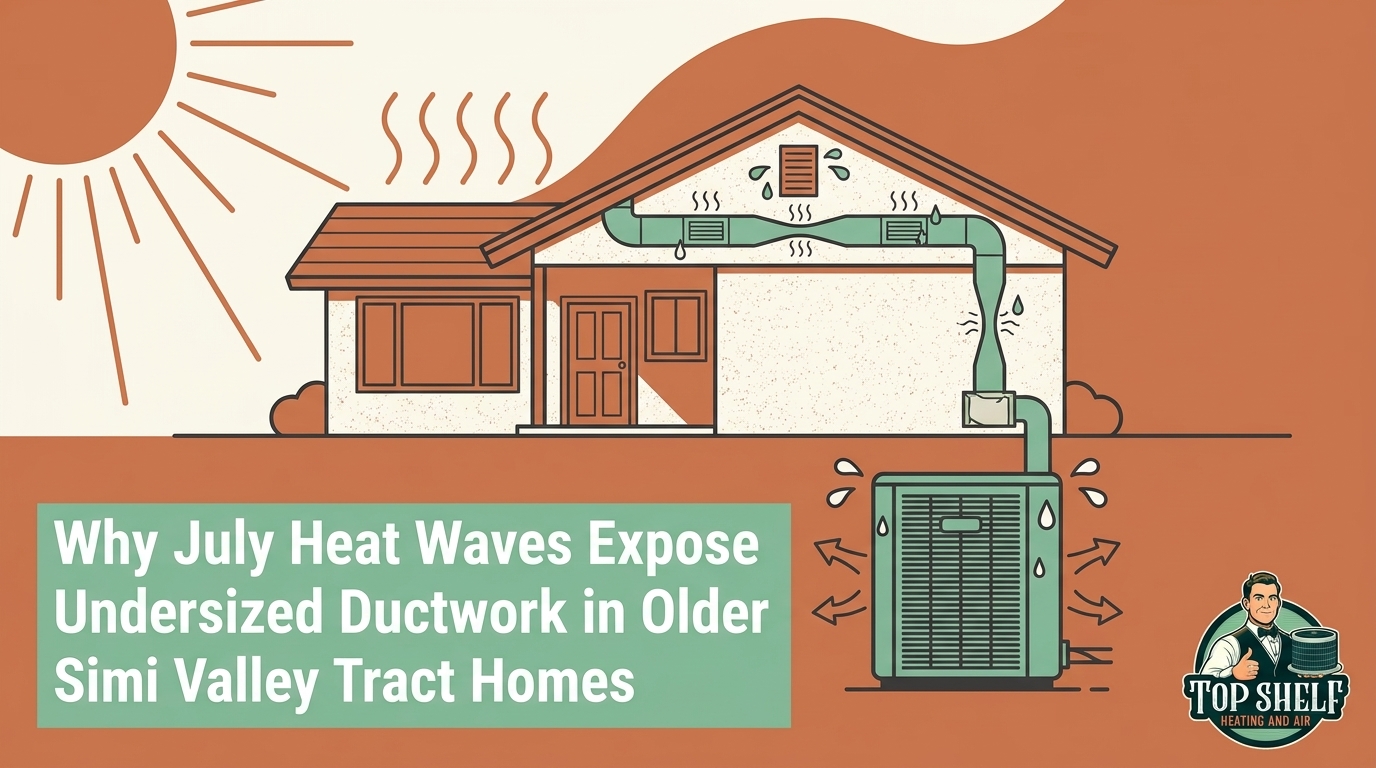
When Your AC Runs Non-Stop But the House Stays Hot
Your thermostat is set to 72 degrees, but the indoor temperature is stubbornly stuck at 82. It is a frustrating reality that perfectly illustrates how heat waves expose undersized ductwork in older Simi Valley tract homes. With summer temperatures regularly exceeding 100 degrees during peak July heat waves, residential cooling loads hit their absolute maximum, exposing fundamental, systemic flaws in how your home moves air.
When an air conditioner runs continuously without actually lowering the indoor temperature, the immediate assumption is usually that the equipment is broken. Most homeowners suspect a failing compressor, a refrigerant leak, or an aging unit that simply does not have enough cooling power anymore. They brace themselves for a massive repair bill or a total system replacement. However, the real, hidden bottleneck is often located right above your head: the original builder-grade ductwork.
If the physical channels carrying air through your home are too small, no amount of cooling power will make the house comfortable. The system simply cannot push enough conditioned air into your living spaces to overcome the extreme heat outside. Recognizing this distinction is the critical decision point for homeowners. You have to decide whether to keep paying for temporary fixes on the cooling unit, or to finally diagnose and address the underlying airflow restriction.
The next step: If you are tired of battling the summer heat, exploring professional ductwork services alongside a comprehensive AC repair in Simi Valley can permanently solve the root cause of your comfort issues.
The Architectural Legacy of 1970s and 1980s Simi Valley Builds
To understand why your home struggles to cool down today, you have to look at how it was built decades ago. During the massive housing development booms of the 1970s and 1980s, construction practices were vastly different. Builders were rapidly constructing neighborhoods to meet high demand, and the standard HVAC installations of the era reflect the technology of the time.
In older Simi Valley tract homes, builders originally sized the ductwork for the lower-capacity, lower-efficiency cooling systems that were standard at the time. A typical air conditioner installed in 1980 moved significantly less air than a modern, high-efficiency system. The metal or fiberglass ducts installed in the attic were perfectly adequate for the smaller blower motors of that era. As a local diagnostic expert familiar with the specific architectural quirks of Ventura County tract homes, a typical pattern we see is foundational infrastructure that was never meant to handle modern airflow requirements.
The Hidden Infrastructure Problem
The core issue is that while appliances get upgraded, the foundational infrastructure often remains untouched. Over the decades, a home might go through three or four different air conditioning units. Each time a unit fails, a slightly larger, more powerful system is often installed to try and combat the intense July heat waves.
However, the ductwork remains hidden behind drywall, tucked into tight attic spaces, and buried between floors. Because replacing ducts requires more labor than simply swapping out an outdoor condenser, the original builder-grade ventilation system is largely ignored as homes change ownership. You end up with a high-powered, modern cooling engine trying to force massive volumes of air through an exhaust system built for a vintage economy car. For comprehensive Simi Valley HVAC services, evaluating this hidden legacy infrastructure is just as important as checking the mechanical equipment itself.
Understanding the Physics of Airflow Bottlenecks
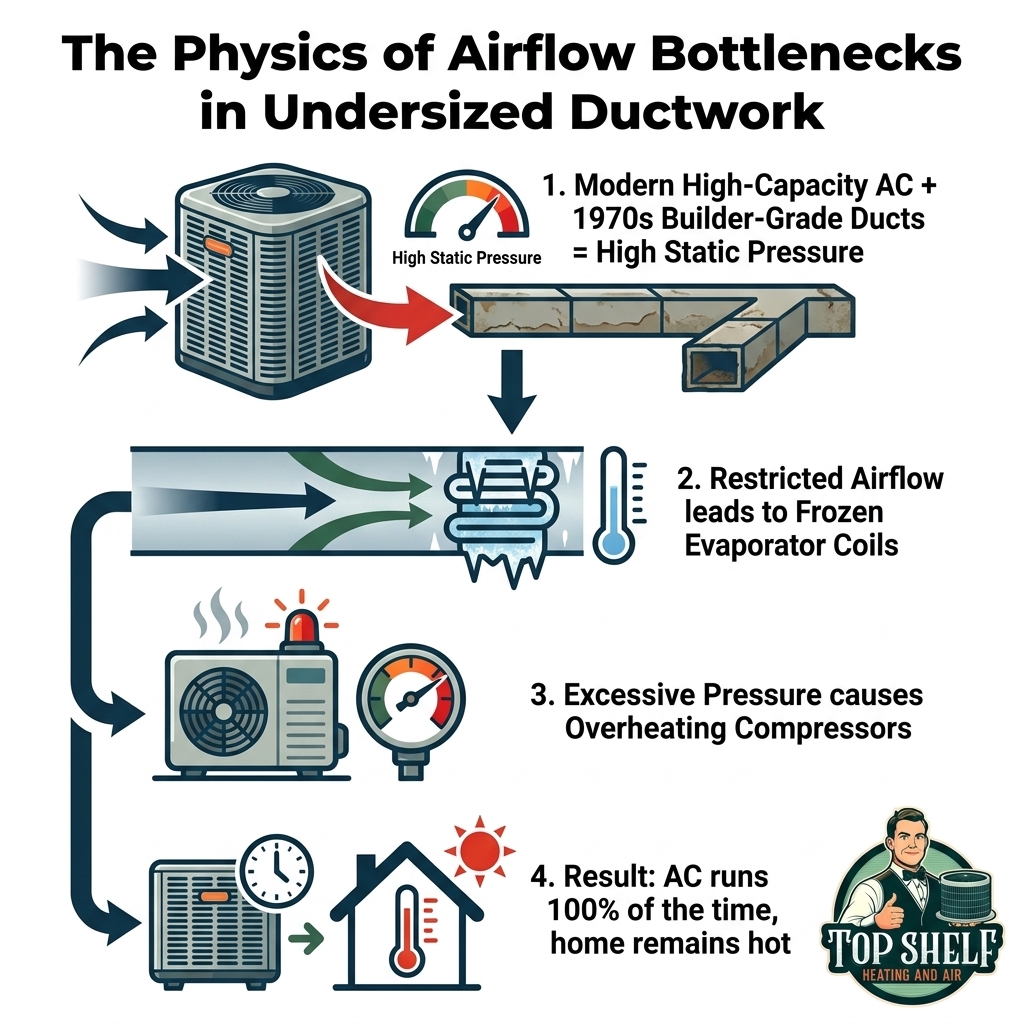
The relationship between your air conditioner and your ductwork comes down to a concept called static pressure. In simple terms, static pressure is the resistance to airflow within your heating and cooling system. When a modern, high-capacity blower motor tries to force a massive volume of air through the narrow ducts of older Simi Valley tract homes, the static pressure spikes dramatically.
Think of it like trying to blow a massive volume of air out of your lungs through a tiny cocktail straw. No matter how hard you push, the air can only travel so fast, and the pressure builds up behind the restriction. In an HVAC system, this restriction creates severe, cascading performance issues throughout the entire mechanical loop.
Why Bigger Isn't Better
When static pressure is too high, the volume of air moving over the indoor evaporator coil drops below the required threshold. The evaporator coil relies on a steady stream of warm indoor air to absorb heat and keep the refrigerant from getting too cold. Without enough airflow, the temperature of the coil plummets. The natural humidity in the air condenses on the freezing metal and turns to solid ice. Once the coil freezes over, the cooling process completely stops, even though the system is still running.
Simultaneously, the excessive pressure forces the blower motor to overwork, consuming excess electricity and burning out prematurely. The outdoor compressor also suffers. If the refrigerant does not absorb enough heat indoors, liquid refrigerant can travel back to the compressor—a condition known as liquid slugging—which can destroy the compressor entirely.
This is why simply paying for a larger AC replacement actually makes this specific problem worse. A larger unit pushes even more air, creating even higher static pressure, faster freezing, and more rapid equipment failure during July heat waves.
Why Maintenance Can't Overcome Structural Sizing Issues
Routine service is the backbone of a healthy cooling system, but it is critical to differentiate between standard maintenance needs and fundamental structural limitations. Many airflow problems share overlapping symptoms. For example, a severely clogged air filter or a blanket of dust over the evaporator coil will restrict airflow and cause the exact same freezing and overheating issues as undersized ducts.
Because the symptoms are identical, homeowners often get stuck in a frustrating cycle of seasonal service calls. A technician arrives, changes the filter, thaws the coil, and adds a bit of refrigerant. The system works adequately during mild spring weather, but the moment the intense July heat waves arrive, the system fails again.
The Limits of Routine Service
While an annual AC tune-up is vital for keeping your equipment running efficiently, it cannot physically expand the diameter of a piece of sheet metal. If your home has a 12-inch return duct when it mathematically requires an 18-inch return duct to support the tonnage of the AC unit, no amount of coil cleaning or filter changing will solve the bottleneck.
This is why measuring actual airflow and static pressure during a service visit is so important. A proper diagnostic visit goes beyond checking electrical connections and refrigerant charges. By measuring the pressure in the supply and return plenums, a technician can definitively rule out structural bottlenecks or confirm that the ductwork in your older Simi Valley tract home is the true limiting factor.
Signs Your Ductwork Is the Real Culprit
You do not need specialized pressure gauges to spot the early warning signs of airflow restrictions. If you pay attention to how your system behaves—especially when it is under heavy load during July heat waves—your home will give you clear indicators that the ductwork is struggling to keep up.
Here is a checklist of the most common signs that your ventilation system is undersized:
• Loud whistling or rushing air noises: If your return grilles sound like a jet engine or your supply vents whistle loudly when the system kicks on, the blower is trying to pull more air than the ducts can comfortably provide.
• Significant temperature imbalances: When ducts are too narrow, the air loses its velocity before it reaches the furthest rooms. This results in a freezing living room and a sweltering master bedroom at the end of the hall.
• Short cycling behavior: If the AC unit shuts off quickly after only a few minutes, the restricted airflow may be causing the internal sensors to overheat and shut the system down defensively.
• Running for hours without cooling: Conversely, if the system runs continuously from noon until sunset but the indoor temperature never drops, the ducts are bottlenecking the delivery of conditioned air.
• Frequent frozen coils: If you find a block of ice on your indoor unit or on the copper lines outside, and your air filter is perfectly clean, poor duct sizing is a highly probable cause.
Comparing Symptoms: Equipment vs. Infrastructure
• Warm air blowing from vents — Likely AC Equipment Issue: Low refrigerant or dead compressor — Likely Ductwork Issue: Torn duct pulling in hot attic air
• System runs constantly — Likely AC Equipment Issue: Unit is old and losing efficiency — Likely Ductwork Issue: Undersized ducts bottlenecking delivery
• Loud whistling noises — Likely AC Equipment Issue: Failing blower motor bearings — Likely Ductwork Issue: High static pressure forcing air through small vents
• Hot and cold spots — Likely AC Equipment Issue: Failing thermostat sensors — Likely Ductwork Issue: Poor airflow reach due to narrow branch ducts
Matching Modern Cooling Capacity to Existing Infrastructure
Solving an airflow crisis requires strict adherence to building science. The Department of Energy (DOE) and Energy Star guidelines emphasize that residential duct sizing must be perfectly matched to the capacity of the heating and cooling equipment. You cannot guess duct sizes based on the square footage of the home alone. The structural realities of older Simi Valley tract homes require precise mathematical modeling to achieve proper airflow.
The Role of Manual J and Manual D Calculations
HVAC professionals rely on two specific calculations to ensure a system breathes correctly. First, a Manual J load calculation determines exactly how much heating and cooling energy the home requires, factoring in insulation levels, window quality, and local climate extremes. Once the exact equipment size is determined, a Manual D calculation is used to design the ductwork.
The Manual D process dictates the exact diameter, length, and layout of the ductwork required to move the necessary volume of air at an acceptable static pressure. Ignoring these standards during an HVAC upgrade is a recipe for disaster. If a contractor simply attaches a new 4-ton air conditioner to a duct system that was originally built for a 2.5-ton unit in 1978, the system will suffocate.
Fortunately, you do not always have to tear down the walls of your home to fix these structural issues. Often, strategic modifications can relieve the pressure. Expanding the main return plenum, adding a secondary return drop in a hallway, or up-sizing a few accessible trunk lines in the attic can drastically reduce static pressure and allow the modern equipment to operate exactly as the manufacturer intended.
Stop Guessing and Start Diagnosing Your Airflow
Shifting the blame from the air conditioning unit to the ductwork is often the key to achieving true, lasting comfort in your home. When you understand that the original builder-grade ductwork in older Simi Valley tract homes acts as a physical bottleneck, the constant breakdowns and poor performance during summer heat waves finally make sense.
Instead of crossing your fingers and hoping that another minor repair or a larger AC unit will magically solve the problem, it is time to seek a comprehensive airflow diagnosis. You need a local expert who understands regional architecture, knows how to accurately measure static pressure, and can engineer a ventilation solution that matches the power of your equipment.
Stop guessing about the health of your HVAC system. Schedule a thorough ductwork and airflow evaluation today to ensure your home is fully equipped to handle whatever the summer weather brings.
Frequently Asked Questions
Why does my AC run constantly during a heat wave?
Your AC runs constantly because it is struggling to remove heat from the home faster than the sun is baking it in. In extreme heat, an AC may naturally run longer, but if the indoor temperature never drops, it indicates a severe bottleneck. Often, undersized ductwork restricts the flow of cold air, preventing the system from satisfying the thermostat.
How do I know if my AC ducts are too small?
The most reliable way to know is through a professional static pressure test, but your home will show physical symptoms first. Look for loud whistling noises at the return vents, significant hot and cold spots throughout the house, and an AC unit that short-cycles or freezes over frequently. These all point to air being forced through channels that are too narrow.
Can you put a new AC on old ductwork?
The short answer is yes, but only if the old ductwork is properly evaluated and mathematically verified to handle the new unit's airflow requirements. Putting a modern, high-capacity air conditioner on 1970s builder-grade ductwork usually results in severe static pressure issues. Strategic duct modifications are often required to make the pairing work efficiently.
Does high static pressure actually damage my air conditioner?
Yes, running an air conditioner with high static pressure causes significant mechanical wear and tear. The blower motor has to work much harder to push air, which can cause it to overheat and burn out prematurely. Furthermore, restricted airflow can cause the indoor coil to freeze, which can send liquid refrigerant back to the outdoor compressor, completely destroying it.
Are all older tract homes built with undersized ductwork?
While not every single home has this flaw, a vast majority of tract homes built during the 1970s and 1980s housing booms feature ductwork sized for smaller, older cooling technology. Builders aimed for cost-efficiency and met the minimum standards of the era. As modern HVAC equipment has grown in size and airflow capacity, those original builder-grade ducts have become a widespread structural bottleneck.
Customer Testimonials


Blogs