


Staging vs. Single-Stage AC Upgrades for Westlake Village Two-Story Homes
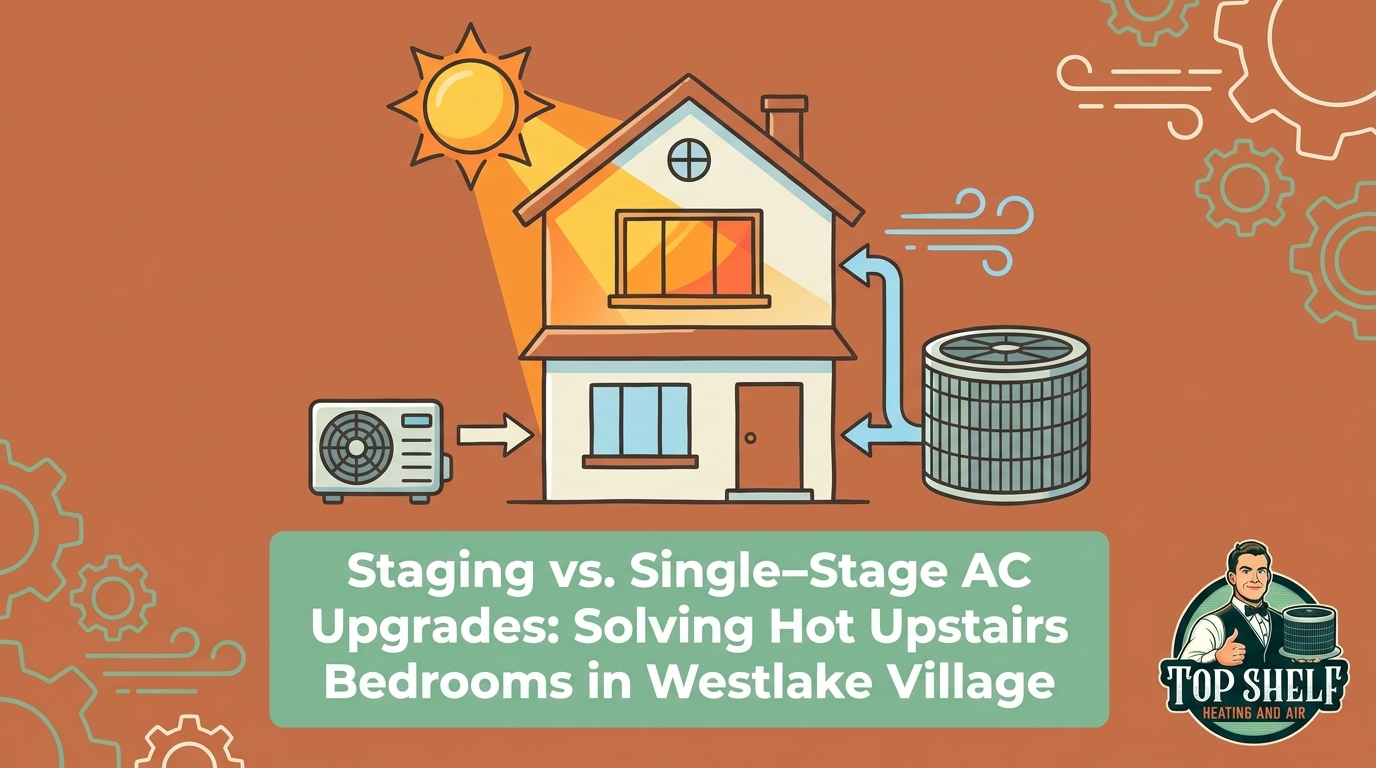
The Myth of the 'Bigger AC' for Hot Upstairs Bedrooms
Bumping up the tonnage on your next cooling system will not magically push cold air up the stairs—in fact, an oversized unit often makes the problem worse. When researching staging vs. single-stage AC upgrades for Westlake Village two-story homes, our technicians at Top Shelf Heating and Air often meet homeowners who mistakenly believe that simply buying a larger unit is the ultimate fix for a sweltering second floor. The reality is much different. Your downstairs thermostat registers the blast of cold air and shuts the system down long before that cooling relief ever reaches the upstairs bedrooms. If you are tired of sleeping in a hot, stuffy room while the living room feels like a refrigerator, the solution lies in how the system operates, not just how big it is.
If you are exploring new air conditioning systems, getting the right AC installation in Westlake Village requires understanding the mechanics of airflow and staging.
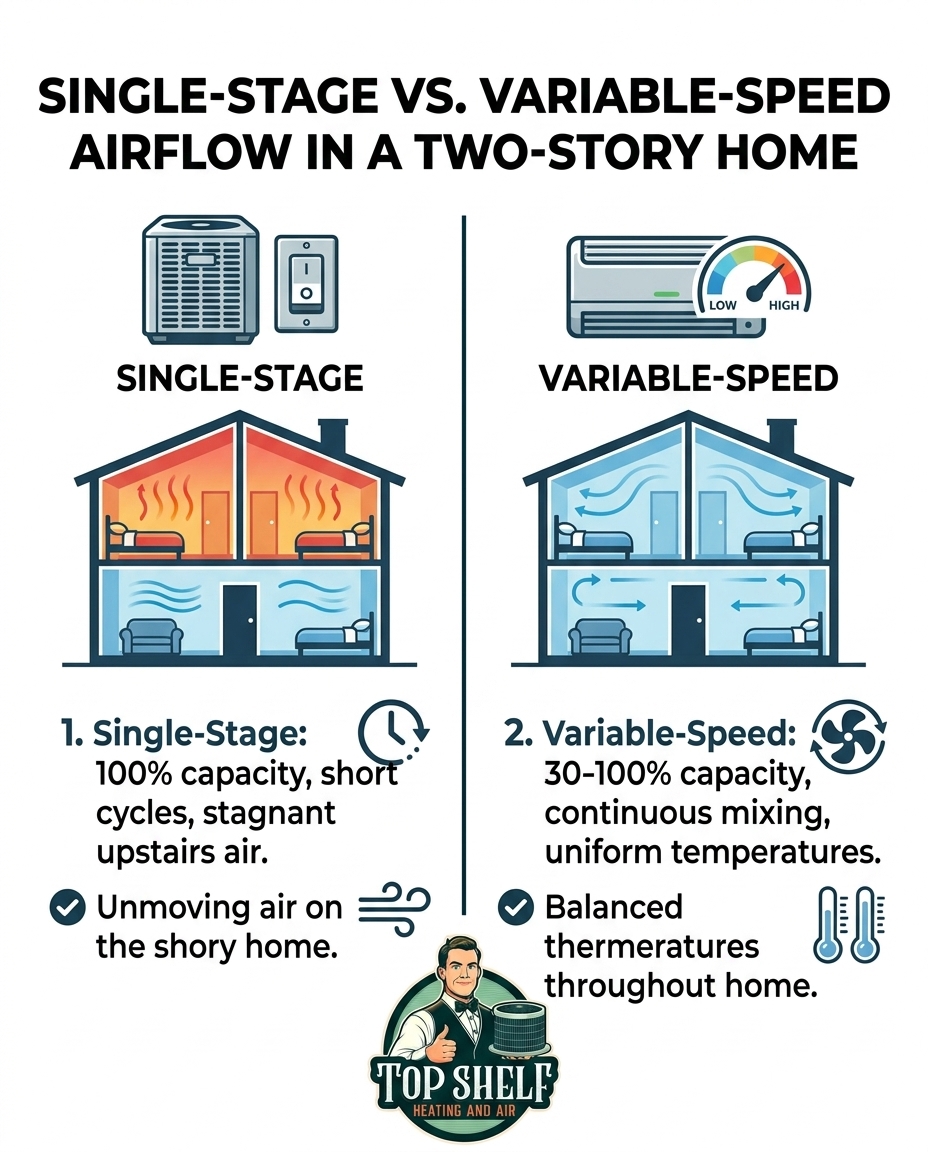
The core dilemma: You need a system that can run long enough to circulate air to the furthest corners of your home without turning the main floor into an icebox. This is the exact decision point between choosing a traditional single-stage air conditioner and investing in a variable-speed (staging) system. A single-stage unit operates like a light switch—it is either entirely on or entirely off. A staging unit operates more like a dimmer switch, adjusting its output to match the precise cooling demand of your home at any given moment.
For homeowners in Westlake Village, the frustration of the upstairs/downstairs temperature split is incredibly common. The architectural layout of these homes practically guarantees that the second floor will absorb the brunt of the daily heat. Solving this requires moving past the myth of the "bigger AC" and looking closely at the physics of how air moves through a multi-level space.
The Physics of Heat Stratification in Two-Story Homes
In our years of servicing multi-level homes throughout Moorpark and Westlake Village, we've found that to understand why your second floor feels like a sauna, you have to look at the thermal dynamics at play inside your house. The standard two-story home HVAC layout fights a constant battle against gravity and thermodynamics. Cold air is dense and heavy, meaning it naturally wants to sink to the lowest level of the house. Conversely, warm air is lighter and naturally rises.
Thermal stratification is the scientific term for this phenomenon. Because heat rises, the ambient temperature on the second floor of a home will naturally be 8 to 10 degrees warmer than the first floor if the air is not actively and continuously mixed. But rising indoor heat is only half of the equation.
Solar heat gain plays a massive role. Hot Southern California summer afternoons create rapid heat gain on second-story roofs. The sun beats down on the shingles, transferring radiant heat into the attic. Even with excellent insulation, that thermal energy eventually radiates down through the ceilings of your upstairs bedrooms. The upper level of your home is essentially being heated from below (rising indoor air) and from above (radiant solar heat).
Airflow resistance complicates things further. Pushing dense, heavy, conditioned air up a vertical ductwork chase requires sustained static pressure. Standard airflow often fails to reach the furthest upstairs vents because the blower motor simply does not run long enough to overcome the resistance of the ductwork and the natural sinking tendency of the cold air. The moment the blower shuts off, the cold air stops moving upward, and the heat immediately begins pooling near the ceiling again. Without a mechanism for continuous air mixing, a two-story layout will always suffer from severe temperature imbalances.
Why Single-Stage AC Systems Struggle Under Peak Load
The Problem: Your upstairs bedrooms remain uncomfortably warm during the summer cooling season, even when the air conditioner runs constantly. You might notice that the system kicks on, blasts air for ten minutes, and then shuts off, leaving the second floor stagnant.
The Cause: Single-stage compressors only have one operational speed: 100% capacity. When the thermostat calls for cooling, the system roars to life, delivering its maximum output. While this sounds powerful, it is highly inefficient for a multi-level home. The thermostat is typically located on the first floor. Because the system is blasting cold air at maximum capacity, it satisfies the downstairs thermostat very quickly. Once the downstairs reaches the target temperature, the system abruptly shuts off.
This creates a destructive "blast and shut off" cycle known as short-cycling. As our team navigates peak July heat calls across our service area, we constantly see these units cycling on and off under maximum load, failing to maintain uniform temperatures. The system never runs long enough to push a sufficient volume of cold air up to the second floor. Furthermore, because the unit shuts down so quickly, it fails to pull enough humidity out of the indoor air, leaving the house feeling clammy and uncomfortable.
The Solution: Upgrading the equipment requires a shift in how the cooling cycle operates. If you are considering an AC replacement, moving away from single-stage operation is often the only way to resolve the short-cycling issue. A system must run for longer, sustained periods to properly dehumidify the air and mix the cold supply air with the warm ambient air trapped upstairs. Single-stage units simply lack the mechanical ability to throttle down and provide that slow, steady circulation.
The Variable-Speed Advantage: Continuous Air Mixing
The mechanics of staging, or variable-speed compressors, directly solve the stratification problem inherent in a two-story home HVAC layout. Unlike a single-stage unit that only knows "100% on" or "100% off," a variable-speed compressor can adjust its cooling output in tiny increments, often running at capacities as low as 30%.
By operating at a lower capacity, the system does not immediately freeze out the first floor. Instead, it runs for much longer, gentler cooling cycles. This extended run time is the secret to upstairs comfort. The longer the blower motor runs, the more it continuously mixes the indoor air. It pulls the hot, stagnant air from the second floor into the return vents, cools it down, and pushes it back up. This continuous circulation prevents the warm air from pooling near the ceiling and ensures the entire home maintains a uniform temperature.
Single-Stage vs. Variable-Speed Cooling Dynamics
Understanding the operational differences helps clarify why staging is so effective for multi-level homes. The metrics below highlight how each system handles the demands of a two-story layout.
• Cooling Capacity — Single-Stage Systems: Fixed at 100% output only. — Variable-Speed (Staging) Systems: Adjustable from roughly 30% to 100% output.
• Cycle Length — Single-Stage Systems: Short, rapid cycles (10-15 minutes). — Variable-Speed (Staging) Systems: Long, continuous cycles (45+ minutes).
• Air Mixing — Single-Stage Systems: Poor. Shuts off before air reaches upstairs. — Variable-Speed (Staging) Systems: Excellent. Constant circulation eliminates hot spots.
• Temperature Swings — Single-Stage Systems: High. Noticeable 3-5 degree fluctuations. — Variable-Speed (Staging) Systems: Minimal. Stays within 0.5 degrees of the thermostat setting.
• Humidity Control — Single-Stage Systems: Weak. Short cycles leave moisture in the air. — Variable-Speed (Staging) Systems: Superior. Extended cycles pull significantly more humidity.
The data clearly shows that variable-speed systems are engineered for consistency. By matching the exact thermal load of the house rather than overwhelming it, these systems provide a level of comfort that a single-stage unit simply cannot replicate.
Custom Design: More Than Just Swapping the Box
Installing a high-end, variable-speed compressor will not fix your upstairs heat if the ductwork and overall system design are fundamentally flawed. Air conditioning is not a plug-and-play appliance; it is a complex network that requires precise engineering. Treating an upgrade as a simple equipment swap is a fast track to disappointment.
A holistic design approach evaluates the entire home's airflow, return vent placement, and thermal load. Return air is critical. Your system cannot push cold air into an upstairs bedroom if the hot air currently in that room has nowhere to go. Without adequate return vents on the second floor to pull the hot air back to the air handler, the supply vents are essentially trying to blow air into a sealed balloon. Pressure builds up, and the cold air simply dumps back down the stairs.
This is where professional expertise becomes non-negotiable. At Top Shelf Heating and Air, we've spent years mastering custom HVAC design for two-story homes. When our team evaluates a home, we do not just look at the metal box outside; we evaluate the static pressure of your ductwork, the insulation levels in your attic, and the specific sun exposure of your Westlake Village or Moorpark property.
Proper AC system upgrades require an engineered approach to guarantee second-floor comfort. Modifying ductwork, adding strategic return drops, and calibrating the blower motor to the precise resistance of your home's layout are all necessary steps to ensure that a variable-speed system performs exactly as intended.
Protecting Your Investment with Proper Maintenance
Transitioning from a basic single-stage unit to an advanced variable-speed system is a significant upgrade in home comfort. However, that advanced technology requires a different level of care to maintain its efficiency and longevity. You are moving from basic mechanical contactors to sophisticated electronic control boards and variable-frequency drives.
Variable-speed systems rely on a network of sensors to monitor indoor temperature, humidity levels, and airflow resistance. If these sensors become dirty or out of calibration, the system cannot accurately adjust its capacity. It might ramp up to 100% unnecessarily, negating the energy savings, or fail to ramp up when the summer cooling season reaches its peak.
Airflow restrictions are the enemy. Because these systems are designed to run at lower speeds, keeping the evaporator and condenser coils spotless is vital. A dirty coil forces the compressor to work harder to transfer heat, reducing the system's ability to operate efficiently at that crucial 30% capacity mark. Likewise, a clogged air filter will cause the variable-speed blower motor to ramp up its RPMs to compensate for the blockage, which dramatically increases wear and tear on the motor.
To keep your system running smoothly through the intense July heat, our service team strongly recommends proactive maintenance. Scheduling an annual AC tune-up ensures that the delicate electronics are communicating properly, the refrigerant charge is exact to the ounce, and the coils are capable of maximum heat transfer. Protecting this investment ensures you get the quiet, continuous air mixing your two-story home demands for years to come.
Frequently Asked Questions About Two-Story AC Upgrades
Is a multi-stage AC worth it for a two-story home?
Yes, because the longer run times eliminate the hot upstairs/cold downstairs dynamic. A multi-stage or variable-speed system runs at a lower capacity for extended periods, which allows the blower to continuously mix the air throughout the entire house. For homeowners in Westlake Village dealing with severe temperature splits, this continuous circulation is the only permanent mechanical solution to achieving uniform comfort on both floors.
Why is my upstairs so hot in the summer?
Heat naturally rises, roofs absorb massive amounts of solar radiation, and standard single-stage units shut off before mixing the air. The radiant heat from your attic pushes down through the ceiling, while the warm ambient air inside the home floats to the second floor. Because a single-stage AC cools the downstairs thermostat so quickly, it shuts down before it can push enough cold air up the ductwork to overcome that trapped heat.
What is the difference between single-stage and variable-speed AC?
A single-stage AC runs at one speed (100% high), while a variable-speed AC adjusts its output to match the exact cooling demand of the home. Think of a single-stage unit like a car that can only drive at 100 miles per hour or be completely parked. A variable-speed unit acts like a car with a gas pedal, smoothly cruising at 30%, 50%, or 80% capacity to maintain the exact temperature you set without abrupt stops and starts.
Will a variable-speed AC help with indoor humidity?
Yes, longer cooling cycles pull significantly more moisture out of the air, vastly improving indoor comfort. An air conditioner removes humidity by passing warm indoor air over the cold evaporator coil, causing condensation. Because variable-speed units run for 45 minutes or more at a low speed, the air spends much more time passing over that cold coil, resulting in superior dehumidification compared to a single-stage unit that only runs for 10 minutes.
Can ductwork modifications fix a hot upstairs without replacing the AC?
Sometimes, adding return air vents to the second floor can improve circulation, but it rarely solves the problem entirely if the compressor is still short-cycling. Proper ductwork is essential for any system to function, but if your single-stage unit continues to blast the downstairs and shut off rapidly, the air simply will not mix. The best results always come from pairing optimized ductwork with a staging compressor.
Making the Right Choice for Your Two-Story Home
When you look at the thermal challenges of a two-story home HVAC layout, it becomes clear that variable-speed staging systems are the definitive solution for hot upstairs bedrooms. Relying on an outdated single-stage unit means accepting a compromise: either freeze on the main floor or sweat on the second floor. By upgrading to a system that can throttle its capacity and run longer, gentler cycles, you ensure that continuous air mixing reaches every corner of your home.
Choosing between staging vs. single-stage AC upgrades for Westlake Village two-story homes ultimately comes down to how much you value consistent, full-home comfort. The technology exists to completely eliminate the stagnant heat trapped in your upper bedrooms. The next step is a professional evaluation to measure your ductwork, assess your thermal load, and design the precise system your home requires to stay perfectly cool all summer long.
Customer Testimonials


Blogs