


Repairing vs. Replacing a Locked AC Compressor After 10 Years of Use
Facing a Locked Compressor on an Aging System?
Have you just been told by a technician that your cooling system has suffered a catastrophic failure right when you need it most? Navigating the decision of repairing vs. replacing a locked AC compressor after 10 years of use requires looking far beyond the immediate repair quote. A seized compressor is one of the most severe mechanical issues a cooling system can experience, and it forces a major financial decision for any homeowner.
With the intense, dry summer heat of July forcing systems in Moorpark CA to run at maximum capacity, these critical failures often happen at the worst possible time. The extreme thermal load pushes aging components past their breaking point, leaving you with a hot house and a difficult choice. Do you invest heavily in replacing a single major component, or is it time to upgrade the entire condensing unit?
Making the right choice means evaluating the long-term viability of your current system, understanding upcoming regulatory changes, and assessing the true cost of keeping an aging unit on life support. For professional air conditioning services that help you navigate these tough calls with clarity, having all the facts is your best defense against buyer's remorse.
What Does a 'Locked Rotor' Actually Mean?
When a technician diagnoses your system with a "locked rotor" or a locked compressor, they are describing a specific, fatal mechanical failure. The compressor acts as the heart of your air conditioning system, responsible for pumping and pressurizing refrigerant through the lines to remove heat from your home. When this component locks up, the internal motor is still receiving electrical current and attempting to start—drawing a massive amount of amperage—but the mechanical parts physically cannot turn.
This condition does not happen overnight. In older units approaching the 10-year mark (standard warranty expiration), a locked compressor is typically the final result of chronic underlying issues. The most common culprits include:
• Thermal overload: Years of operating with dirty coils, low airflow, or extreme peak-summer temperatures cause the compressor to run dangerously hot, eventually warping internal components.
• Electrical failure: A failing capacitor or a history of power surges can degrade the motor windings over time, leading to a sudden short or mechanical seizure.
• Loss of lubrication: Just like a car engine, a compressor relies on internal oil for lubrication. Over a decade of use, refrigerant leaks or acid buildup can compromise this oil, causing metal-on-metal friction that seizes the motor.
One critical fact homeowners must understand is that a locked compressor cannot simply be "un-stuck" or lubricated back to life. The internal damage is permanent, and it almost always requires the complete removal and replacement of the component. Furthermore, because a locked rotor draws dangerously high electrical currents, a licensed professional must perform this diagnosis and any subsequent work. Attempting to reset breakers repeatedly or force the system to run can cause severe electrical damage to your home.
If you are facing this diagnosis, exploring AC system replacement is often the most logical next step, as it addresses the root cause of the failure rather than just treating a symptom.
The Warranty Trap: Hitting the Critical Decade Milestone
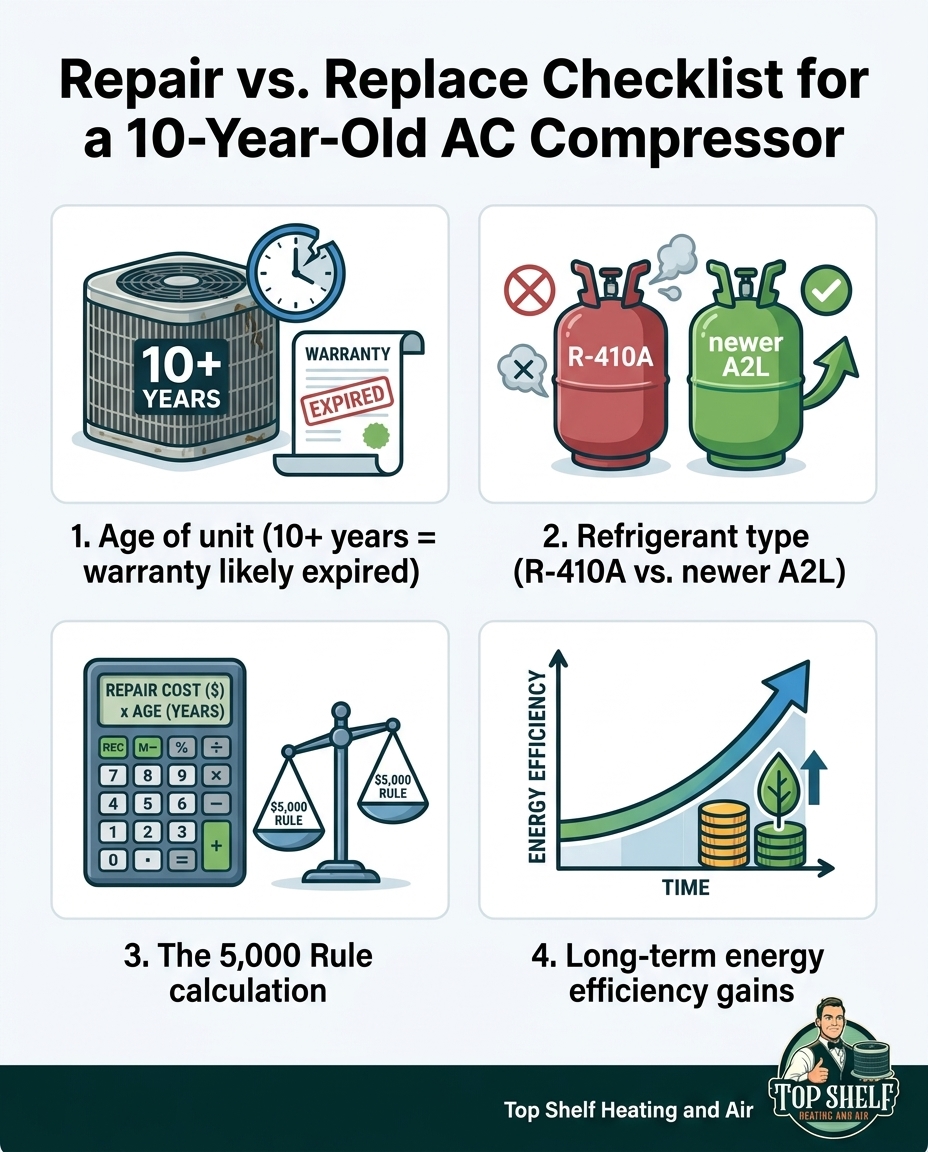
The age of your air conditioning unit is the single most important variable when deciding how to handle a locked compressor. The HVAC industry operates on highly standardized timelines, and understanding these timelines is vital for protecting your wallet. The vast majority of standard manufacturer parts warranties expire exactly at the 10-year mark (standard warranty expiration). If your system was installed a decade ago, you are likely crossing a critical threshold where all financial liability shifts directly to you.
Replacing a compressor out-of-pocket on an out-of-warranty system is an incredibly heavy investment. The part itself is expensive, and the labor required to recover the old refrigerant, braze in the new compressor, pull a deep vacuum, and recharge the system is extensive. This is where many homeowners fall into the "sunk-cost fallacy." They assume that because they have already invested in maintaining the unit, they should just pay for the repair. However, installing a brand-new compressor into a decade-old condensing unit means you are connecting a pristine new "heart" to an aging body. The older condenser coils, the fan motor, the contactor, and the reversing valve are all still 10 years old and statistically likely to fail soon.
To evaluate this objectively, industry professionals often recommend the "5,000 rule." This is a simple mathematical baseline for decision-making: you multiply the age of the equipment by the estimated repair cost. If the resulting number exceeds 5,000, the baseline recommendation is to replace the entire system rather than proceed with the repair. For a 10-year-old system, any repair estimate that drives that calculation over the threshold is a strong indicator that the unit has reached the end of its financially viable lifespan.
Providing an honest, transparent cost-benefit analysis helps homeowners avoid wasting money on obsolete units. When you are looking at AC repair in Moorpark, working with a team that lays out the math clearly ensures you aren't pressured into a short-sighted fix that will inevitably lead to more breakdowns next season.
How the R-410A Phase-Out Impacts Your Repair Decision
Beyond the immediate mechanical failure and the expiration of your warranty, there is a massive regulatory shift occurring in the HVAC industry that directly impacts your decision. If your system is 10 years old, it almost certainly uses R-410A refrigerant. While this was the industry standard for over a decade, it is currently being phased out by the federal government due to its environmental impact.
Under the EPA's AIM Act, there is a mandatory, aggressive phasedown of high-Global Warming Potential (GWP) refrigerants, which includes R-410A. The industry is rapidly shifting toward newer, more environmentally friendly A2L refrigerants. This is not just a federal guideline; California's strict environmental regulations and Title 24 updates actively accelerate this transition, making legacy system maintenance increasingly difficult and costly in the state.
What does this mean for a homeowner in Moorpark CA facing a locked compressor? It means that repairing your 10-year-old system ties you to a dying technology. As the production of R-410A is slashed year after year, the supply will dwindle, and the cost to acquire it will rise sharply. If you replace your compressor today, but your older evaporator coil develops a leak two years from now, recharging that older system with R-410A will become an immense financial burden.
Relating California's specific regulatory environment to your long-term maintenance strategy is vital. Full replacement is no longer just about getting a new machine; it is about future-proofing your home's cooling infrastructure. Upgrading to a new system that utilizes modern A2L refrigerants ensures that your equipment remains compliant, easily serviceable, and fully supported for the next ten to fifteen years.
Side-by-Side: Compressor Repair vs. Full Unit Replacement
When you are standing in your yard sweating through a July heatwave, it can be difficult to weigh the abstract pros and cons of major HVAC work. To make the decision clearer, it helps to look at the short-term impacts and long-term realities side-by-side. The choice between swapping the compressor and upgrading the entire system fundamentally comes down to balancing immediate out-of-pocket expenses against long-term reliability and efficiency.
The table below breaks down how these two paths compare across the most critical categories for homeowners.
• Short-Term Impact — Compressor Replacement Only: Solves the immediate failure, gets cooling back online quickly. — Full Unit Replacement: Requires a comprehensive installation process and a larger initial investment.
• Long-Term Reliability — Compressor Replacement Only: Low. A new compressor is mismatched with aging 10-year-old coils and motors. — Full Unit Replacement: High. All components are factory-matched, clean, and designed to work together.
• Warranty Status — Compressor Replacement Only: The new compressor may have a limited part warranty, but the rest of the unit remains unprotected. — Full Unit Replacement: Resets the clock completely, typically providing a comprehensive 10-year warranty on all parts.
• Energy Efficiency — Compressor Replacement Only: Remains at the degraded efficiency level of a decade-old system. — Full Unit Replacement: Significant gains in efficiency due to modern SEER2 standards and advanced technology.
Pros and Cons of Compressor Replacement Only
Choosing to only replace the compressor is a path some homeowners take if they are planning to move out of the house in the very near future. However, it carries significant drawbacks.
• Pro: It solves the immediate mechanical failure without requiring the removal of the entire outdoor unit and indoor coil.
• Con: You face high out-of-pocket parts and labor costs with absolutely no warranty protection on the surrounding aging components, which are highly likely to fail next.
• Con: It keeps your home entirely reliant on the phasing-out R-410A refrigerant, guaranteeing that future leaks will be exceptionally difficult to manage.
Pros and Cons of Full Unit Replacement
Opting for a complete system replacement is an investment in the future comfort and valuation of your home. When you are considering replacing your AC in Moorpark, the long-term benefits typically outweigh the initial hurdles.
• Pro: It completely resets the warranty clock, offering you another decade of protection against major component failures.
• Pro: It transitions your home to modern, compliant refrigerants (A2Ls), shielding you from the volatility of the R-410A phase-out.
• Pro: It significantly lowers your monthly energy consumption due to vastly improved SEER2 ratings and modern compressor technology.
• Con: It requires a larger upfront investment and coordination for a full day of installation work.
Offsetting Costs with Modern Efficiency and Incentives
The financial apprehension of a full replacement is entirely understandable. However, it is crucial to factor in how much money a decade-old system is already costing you in wasted electricity. An air conditioner loses efficiency over time, especially when running constantly during peak summer heat. The wear on the coils, the degradation of the motor windings, and the buildup of internal friction mean that a 10-year-old system draws significantly more electricity to produce the same amount of cooling it did when it was new.
Modern systems are tested under the rigorous new SEER2 (Seasonal Energy Efficiency Ratio 2) standards. These new testing conditions more accurately reflect real-world operating environments. A new SEER2-rated system provides superior cooling performance while drawing substantially less electricity from the grid. Over the lifespan of the new unit, these monthly energy savings act as a direct offset to the initial installation investment.
Furthermore, upgrading to a high-efficiency system often unlocks financial assistance that is completely unavailable for repair work. Homeowners are strongly encouraged to explore local utility programs, manufacturer promotions, and state-level incentives that make upgrading more accessible. Between federal tax credits for energy-efficient home improvements and specific California state rebates, the net cost of a new system can be brought down considerably. Taking the time for finding HVAC rebates and energy incentives can transform a daunting expense into a highly strategic home upgrade.
Frequently Asked Questions About 10-Year-Old AC Compressors
Is it worth replacing an AC compressor on a 10-year-old unit?
The short answer is usually no. Once an AC unit reaches the 10-year mark (standard warranty expiration), the original parts warranty has typically expired, leaving you responsible for the full cost of the compressor and the extensive labor required to install it. Furthermore, placing a brand-new compressor into a decade-old system leaves you vulnerable to the failure of other aging components, such as the condenser fan motor or the evaporator coil, which will require additional costly repairs shortly after.
Can a locked AC compressor be fixed without replacing it?
A locked AC compressor cannot be repaired or "un-stuck"; it must be entirely replaced. When a compressor locks up, it means the internal mechanical components have seized due to severe thermal overload, electrical burnout, or a catastrophic loss of internal lubrication. Because the internal casing is hermetically sealed and the damage is permanent, the only mechanical solution is to remove the failed compressor, flush the lines, and braze in a completely new unit.
How does the R-410A phase-out affect my AC repair?
The EPA's phasedown of R-410A makes repairing older systems a significant financial risk. As the production of R-410A decreases, the cost to acquire this legacy refrigerant will continue to rise sharply. If you repair a 10-year-old unit today and it develops a refrigerant leak two years from now, the cost to recharge that system will be excessively high. Upgrading to a new system utilizes modern A2L refrigerants, protecting you from these future supply shortages.
How long will a new AC compressor last in an old unit?
While a new compressor itself is built to last a decade, its lifespan is severely compromised when installed in an old unit. The new compressor must work with the existing 10-year-old condenser coils, metering devices, and electrical contactors. If the original coils are degraded or airflow is restricted, the new compressor will operate under immediate thermal stress, significantly increasing the likelihood that it will fail prematurely compared to a compressor in a fully matched, brand-new system.
What are the symptoms of a locked up AC compressor?
If you notice your AC system is blowing warm air while the outdoor unit makes a harsh humming, buzzing, or clicking sound without the fan running properly, that usually means the compressor is struggling to start. A locked compressor will draw excessive electrical amperage, which frequently causes the dedicated circuit breaker in your electrical panel to trip repeatedly. If you experience these symptoms, leave the system off and call a professional immediately to prevent electrical damage.
Make the Right Choice for Your Home's Cooling Future
Facing a locked compressor on an aging system is undoubtedly stressful, but it also presents a critical opportunity to transition away from obsolete technology. By understanding the severe limitations of patching a decade-old unit, you can make a choice that protects your home and your wallet over the long term. The combination of the impending R-410A phase-out, the reality of the 10-year mark (standard warranty expiration), and the inevitable failure of surrounding older components makes full unit replacement the most secure path forward for homeowners in Moorpark CA.
You do not have to make this decision in the dark. Relying on a clear, objective framework that compares immediate repair costs against long-term return on investment ensures you are making a financially sound choice. If your system has suffered a major failure, schedule a professional evaluation today to review your specific equipment's condition, verify your exact warranty status, and map out the smartest cooling strategy for your home's future.
Customer Testimonials


Blogs