

Why Rinsing Your AC Condenser Coils Isn't Enough for Ventura County Dust
The Illusion of the Garden Hose Rinse Against Baked-On Dust
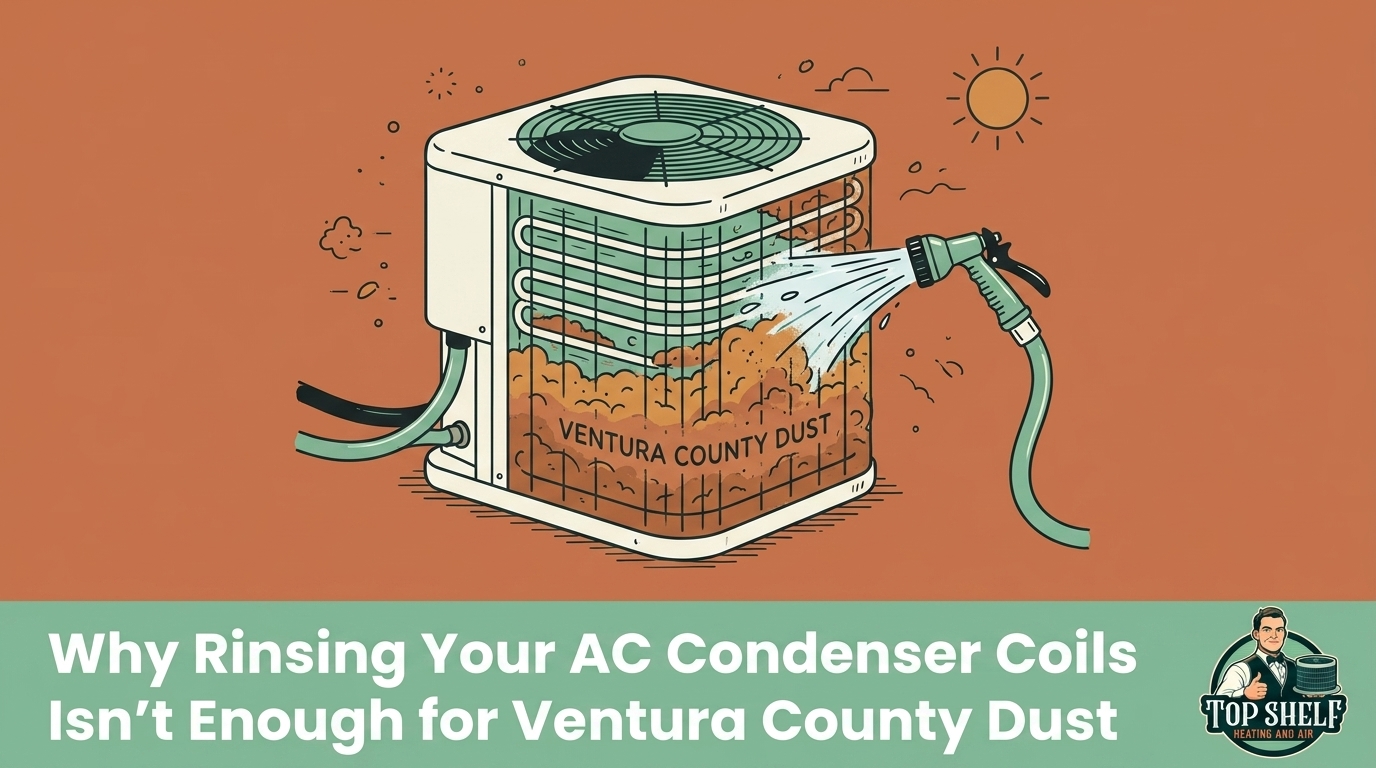
Your air conditioner is running nonstop, but the house still feels warm, which perfectly illustrates why rinsing your AC condenser coils isn't enough for Ventura County dust when you attempt a quick DIY clean. You walk outside, notice a thick blanket of dirt coating the outdoor unit, and instinctively reach for the garden hose. It makes sense on the surface—water washes away dirt, right? While a quick spray might dislodge a few loose leaves or surface spider webs, our technicians at Top Shelf Heating and Air can tell you firsthand that it completely fails to penetrate the microscopic, stubborn layer of agricultural dirt baked onto the delicate aluminum fins.
In our years serving the community, we constantly see homeowners assume this superficial rinse is all the outdoor condenser unit needs to survive the summer. However, relying on a standard garden hose creates a false sense of security. The dirt that accumulates on systems in Moorpark CA and surrounding Ventura County agricultural zones is not typical household dust; it is a heavy, mineral-rich particulate that clings fiercely to hot metal. When you are standing in your yard with a hose, you face a critical decision: continue relying on ineffective DIY rinsing that slowly suffocates your system, or invest in professional chemical cleaning that actually protects the compressor.
Addressing this specific environmental challenge is exactly why proper Air Conditioning Services are essential for homeowners in our region. A standard wash simply cannot break the bond between the baked-on silt and the aluminum fins. To truly restore heat transfer and protect your investment while the extreme July heat bears down, scheduling professional AC maintenance in Moorpark is the only guaranteed way to clear the debris safely and effectively.
The Physics of Heat Transfer Under Peak Summer Load
To understand why plain water fails, our team often explains to customers exactly how your air conditioner cools your home. The outdoor condenser's primary job is not to create cold air, but to release the heat absorbed from inside your house into the outdoor air. This entire heat rejection process relies completely on the surface area of the thousands of delicate aluminum fins surrounding the compressor. The more surface area exposed to the air, the faster the heat dissipates.
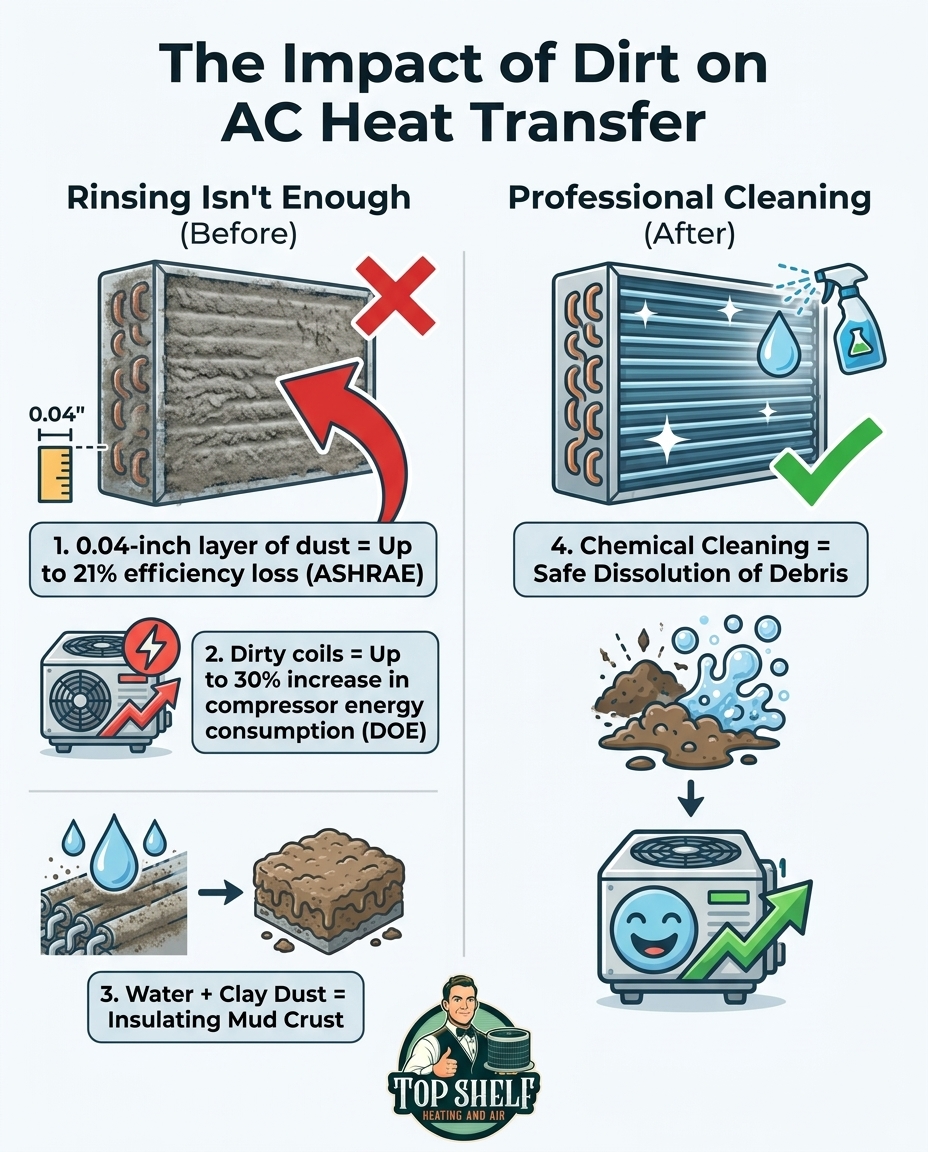
According to the American Society of Heating, Refrigerating and Air-Conditioning Engineers (ASHRAE), even a microscopic 0.04-inch layer of dust acts as heavy insulation on these fins. That tiny fraction of an inch can reduce your system's cooling efficiency by up to 21%. When those aluminum fins are insulated by a blanket of dirt, the hot refrigerant inside the coils cannot cool down. Because the heat has nowhere to go, your system is forced to run longer, work harder, and operate at significantly higher temperatures just to achieve the same indoor comfort.
Tackling this issue during the peak summer cooling season is critical because heavy daily loads push already-strained systems past their breaking point. When the outside temperature spikes, a dirty condenser simply cannot reject enough heat to keep the refrigeration cycle moving efficiently.
Why Airflow is Non-Negotiable
Condenser fans are engineered to pull massive volumes of air through the incredibly narrow gaps between the aluminum fins. These gaps are often only fractions of a millimeter wide. Any blockage in these pathways immediately spikes the internal temperature and pressure of the compressor.
• Restricted heat rejection: The fan spins, but no fresh air moves across the coils to carry the heat away.
• Elevated refrigerant pressure: Unable to cool down, the refrigerant remains at a high pressure, forcing the compressor motor to work against heavy resistance.
• Thermal overload: The compressor eventually overheats and triggers a safety shutoff, leaving you without cooling on the hottest days of the year.
Why Local Agricultural Soil Requires a Different Approach
Standard suburban dust found in other parts of the country is mostly composed of loose particulate matter, dead skin cells, and light pollen that easily blows away with a breeze or a light rinse. However, our local agricultural zones produce a completely different type of debris. The soil here is heavy in fine silt and clay, which behaves drastically differently under extreme heat and moisture conditions.
With summer temperatures regularly soaring, we see how the dry Santa Ana winds sweep through Moorpark CA and surrounding Ventura County agricultural zones, driving this ultra-fine particulate matter deep into the narrow crevices of your outdoor condenser. The wind doesn't just deposit the dirt on the surface; it forces it deep between the aluminum fins where it settles tightly against the copper tubing.
We've seen this exact scenario play out on hundreds of local service calls: the real problem occurs when this fine agricultural dust meets moisture. When the dry, dusty Santa Ana wind conditions give way to heavy morning coastal dew, that moisture seeps into the silt trapped in your AC unit. The combination of fine clay dust and morning dew creates a slurry. Then, when your air conditioner turns on in the afternoon heat, the high temperatures from the compressor bake that slurry directly onto the metal. This specific local soil composition forms a cement-like, hardened crust on the hot metal surfaces that is practically impervious to a standard garden hose.
The 'Mud Effect': How Water Traps Heat Inside Your Condenser
When you stand over your condenser with a garden hose and spray plain water onto clay-heavy agricultural dust, you are not washing it away. Instead, you are triggering what our HVAC professionals call the "mud effect." The water mixes with the fine silt, instantly turning it into a thick, sticky mud.
Because the gaps between the aluminum fins are so tight, the force of the water from the hose actually pushes this newly formed mud deeper into the center of the coil block. It moves from the outer surface, where it was at least partially exposed to the air, into the dense core of the unit where it becomes completely trapped. You might look at the outside of the unit and think it looks clean, but the interior pathways are now completely clogged with wet clay.
Once you go back inside and the AC turns back on, the extreme heat from the compressor goes to work on that trapped moisture. It literally bakes the mud into a solid, insulating ceramic-like crust deep inside the coil. This is exactly why systems we service often blow warm air or struggle to cool the house immediately after a DIY wash. The homeowner inadvertently created a brick wall inside their condenser, severely restricting airflow and prompting the immediate need for an AC tune-up during the crucial peak summer cooling season.
• DIY Garden Hose — Immediate Result: Turns agricultural dust into thick mud — Long-Term Impact on Coils: Pushes mud deeper, baking it into an insulating crust
• High-Pressure Washing — Immediate Result: Flattens delicate aluminum fins instantly — Long-Term Impact on Coils: Blocks airflow permanently, risking compressor death
• Professional Chemical Wash — Immediate Result: Dissolves the bond between clay and metal — Long-Term Impact on Coils: Restores factory-level heat transfer and airflow safely
The Hidden Dangers of High-Pressure Washing
Frustrated by the baked-on mud that won't wash away with a standard hose, many homeowners escalate their DIY efforts. They often resort to high-pressure nozzles, stiff bristle brushes, or even power washers to blast the dirt away. Our field technicians can confirm this is one of the most destructive things you can do to an air conditioning system in Moorpark CA and surrounding Ventura County agricultural zones.
Condenser fins are manufactured from incredibly thin, fragile aluminum. They are designed this way specifically to maximize surface area and heat transfer, not to withstand physical force. When you apply high pressure to these fins, you risk catastrophic damage to the system.
1. Flattening the fins: The sheer force of a high-pressure nozzle will instantly bend and flatten the delicate aluminum fins against each other. Once flattened, the gaps are sealed shut.
2. Total airflow blockage: Flattened fins mean zero air can pass through that section of the coil. The fan cannot pull air across the copper tubes, trapping all the heat inside the system.
3. Compressor failure: With the airflow blocked, the compressor overheats rapidly. The internal pressure spikes beyond safe operating limits, leading to mechanical failure and a completely dead system.
4. Expensive corrections: Fixing a unit with heavily flattened fins requires specialized tools to painstakingly comb them back into place, or worse, replacing the entire coil or burned-out compressor. This requires extensive AC repair services that could have been entirely avoided.
The Science of Professional Chemical Coil Cleaning
To safely remove baked-on clay without damaging the fragile aluminum fins, the bond between the dirt and the metal must be broken chemically, not forcefully. This requires a scientific approach to maintenance, rather than just applying more water pressure.
Top Shelf Heating and Air utilizes specialized professional chemical coil cleaners to safely dissolve agricultural dust without damaging the delicate aluminum fins. These professional-grade foaming cleaners are specifically formulated for HVAC applications. When applied, the chemical solution expands deep inside the unit, penetrating the tight spaces where the mud has baked onto the copper and aluminum.
The foaming action is critical because it works from the inside out. As the foam expands, it lifts and pushes the heavy debris outward, away from the core of the coil. The specialized formulas actively dissolve the tough agricultural crust, breaking down the mineral bonds of the clay and silt. Once the crust is dissolved into a loose liquid state, it can be gently rinsed away at a very low, safe pressure. Taking care of this during the peak summer cooling season is the only proven way to restore factory-level heat transfer safely, ensuring your system can breathe easily when the peak July temperatures hit.
The True Cost of Operating with Dirty Coils During Peak Heat
Our maintenance crews know that ignoring the caked-on dust on your condenser doesn't just result in a warmer house; it leads to severe efficiency and comfort penalties. Operating an air conditioner with insulated, dirty coils forces the entire system to work overtime, drawing significantly more electricity just to maintain baseline cooling.
According to the Department of Energy, the strain of pushing heat through dirty coils can increase your compressor's energy consumption by up to 30%. That means a significant portion of the energy used to cool your home is entirely wasted fighting against a wall of baked-on mud. Over the course of a long, hot summer, that wasted electricity adds up to a substantial efficiency loss.
Beyond the immediate spike in your monthly energy bills, the continuous extreme heat takes a severe toll on the mechanical components of your system. The compressor relies on internal lubricants to function smoothly. When the system operates at elevated temperatures due to blocked coils, those lubricants break down and degrade. Without proper lubrication, the compressor suffers from excess friction, leading to premature mechanical failure. Understanding this chain reaction underscores why an annual AC tune-up is crucial for optimal cooling and system longevity, especially before the July heat peaks push your equipment to its absolute limits during the peak summer cooling season.
Common Questions About AC Coil Cleaning
Can I just spray my AC unit with water?
No, spraying your AC unit with plain water is not recommended for heavy agricultural dust. While it might wash away surface leaves, water mixes with local clay-heavy soil to create a thick mud. This mud gets pushed deeper into the fins and bakes into a hard crust when the unit turns on, restricting airflow even further.
Why is my AC still blowing warm after I hosed it off?
If your AC is blowing warm after hosing it off, you likely created the "mud effect" inside the condenser coils. The water pushed the dirt deeper into the unit, blocking the airflow necessary for heat transfer. Without proper airflow, the refrigerant cannot cool down, resulting in warm air entering your home.
What is the best way to clean outside AC coils?
The safest and most effective way to clean outside AC coils is using a professional-grade foaming chemical cleaner. These specialized solutions chemically break the bond between baked-on dirt and the metal fins, pushing debris outward so it can be rinsed away gently without bending the delicate aluminum.
What happens if AC condenser coils are dirty?
When AC condenser coils are dirty, they act as an insulating blanket that traps heat inside the system. This forces the compressor to run longer and hotter, increasing your energy consumption by up to 30%. Over time, this excessive heat degrades internal lubricants and leads to premature system failure.
Does cleaning AC coils improve cooling?
Yes, cleaning AC coils directly improves your system's cooling capacity. By removing the insulating layer of dirt, the aluminum fins can effectively release the heat absorbed from your home into the outside air. This restores the system's efficiency, allowing it to cool your house faster and use less electricity.
Can baked-on mud cause my AC compressor to overheat?
Absolutely, baked-on mud is a primary cause of compressor overheating. The mud blocks the vital airflow needed to cool the hot refrigerant. As the temperature and pressure build up inside the system, the compressor motor works against extreme resistance until it eventually overheats and shuts down.
Restore Your System's Cooling Power Safely
While a garden hose is great for watering your plants and washing your car, our team at Top Shelf Heating and Air knows it is entirely the wrong tool for battling local agricultural dust on your HVAC equipment. The unique combination of fine silt, clay, and coastal moisture creates a stubborn barrier that plain water simply turns into damaging mud. Protecting the delicate aluminum fins on your outdoor unit is paramount for your system's longevity and your home's comfort.
Instead of risking flattened fins or a burned-out compressor with DIY high-pressure washing, you should rely on professional chemical cleaning to truly restore your system's efficiency. By breaking the bond between the dirt and the metal safely, you ensure your air conditioner can reject heat properly all summer long. If you suspect your unit is caked in dirt from the recent winds, take advantage of the peak summer cooling season and schedule professional AC maintenance in Moorpark to keep your system running at peak performance.
Customer Testimonials


Blogs