


Diagnosing a Blown AC Capacitor During Moorpark's Peak July Heat
Is That Clicking Sound a Quick Fix or a Dead Compressor?
Is your air conditioner making a strange clicking noise while the house continues to heat up? Diagnosing a blown AC capacitor during Moorpark's peak July heat is often the first step to restoring your comfort before panic sets in. It is a terrifying moment for any homeowner. You walk outside to check the unit, expecting to hear the familiar roar of the cooling cycle, but instead, you are greeted by a faint, repetitive click and a fan that refuses to move. When a peak July heat (100-degree day) strikes, an unresponsive air conditioner feels like an absolute emergency.
If you are worried about the health of your air conditioning systems, scheduling professional AC repair in Moorpark is the safest way to get your home cool again.
Most homeowners immediately fear the worst: a dead compressor. The compressor is the heart of your cooling system, and replacing it is a major, labor-intensive undertaking. However, these specific sensory clues—a distinct clicking noise combined with warm air blowing from your indoor vents and a motionless outdoor fan—often point to a much simpler electrical issue.
Understanding these symptoms is the first step before calling for professional diagnostics. A blown capacitor is an incredibly common point of failure during extreme weather. It acts as the gatekeeper for your system's power. When it fails, the entire cooling process halts, mimicking the symptoms of a catastrophic system failure. By learning to identify the sounds and visual cues of a struggling capacitor, you can replace panic with a clear plan of action.
Sensory Clues: What Does a Blown AC Capacitor Sound Like?
To understand what a blown capacitor sounds like, you first need to understand what this small component actually does. Think of the capacitor as a heavy-duty battery that jump-starts the motors in your outdoor unit. Your air conditioner requires a massive jolt of electricity to start the compressor and the fan motor—far more power than your home's standard electrical wiring can provide all at once. The capacitor stores energy and releases it in a powerful burst to get those heavy motors spinning. Once they are running, a continuous supply of lower-voltage electricity keeps them going.
When this component fails, the motors cannot start. This creates a highly specific set of sensory clues. If you stand near your outdoor unit during a cooling cycle, a failed capacitor will typically produce the following symptoms:
• The repetitive clicking sound: This is often the most noticeable symptom. The clicking is the sound of the contactor (an electrical switch) engaging. The thermostat tells the system to turn on, the contactor closes to allow electricity to flow, but without the stored power from the capacitor, the motors cannot start. The system may repeatedly try to engage, resulting in a rhythmic clicking noise.
• The low, strained humming sound: If you hear a deep buzzing or humming noise, this indicates that the fan motor or compressor is receiving voltage but lacks the starting torque to actually spin. The motor is essentially locked in place, vibrating with electrical current but unable to move. This is known as "locked rotor amps" and puts immense strain on the equipment.
• The visual fan failure: A clear visual symptom of a blown capacitor is a completely stationary fan blade. You will hear the clicking sound and fan failure simultaneously. The system is attempting to run, you might hear the humming of electricity, but the fan blades on top of the outdoor unit remain completely still.
• Warm air from indoor vents: Because the outdoor unit (the condenser) is not running, the system cannot remove heat from your home. The indoor blower motor will continue to circulate air, but that air will be warm and unconditioned.
These sounds are your system's cry for help. Recognizing the difference between a mechanical grinding noise and an electrical hum is incredibly helpful when describing the problem to a technician.
Why Moorpark's Extreme Summer Weather Destroys Electrical Components
Air conditioning capacitors do not just fail randomly; they are highly susceptible to environmental stress. To understand why this happens, we have to look at how Moorpark's extreme summer weather directly impacts electrical components. Inside the metal casing of a capacitor, there is a specialized dielectric fluid or oil that helps store the electrical charge and dissipate heat. This fluid is highly sensitive to temperature fluctuations.
The Impact of Continuous 100-Degree Heat
With summer temperatures regularly exceeding 100°F in Moorpark, CA, your air conditioning system is forced to run in extended, heavy cooling cycles. During a mild day, the system turns on, cools the house, and shuts off, giving the internal components time to cool down. During a peak July heatwave, the system might run almost continuously for hours on end just to maintain a livable indoor temperature.
This lack of cool-down periods directly leads to component degradation. The capacitor is already generating its own internal heat as it stores and releases high-voltage electricity. When you combine that internal operational heat with the relentless external heat of the Moorpark sun beating down on the metal condenser cabinet, the thermal stress becomes overwhelming.
As the internal temperature of the capacitor rises beyond its design limits, the dielectric fluid begins to boil and expand. This thermal overload causes the top of the metal casing to bulge outward—a phenomenon technicians often refer to as "mushrooming." Once the casing swells, the internal connections break, and the component loses its ability to hold a charge. In severe cases, the capacitor can leak fluid or blow completely, resulting in a sudden and total loss of cooling power.
Because this thermal stress builds up cumulatively over time, keeping your system clean is one of the best defenses. Dirty condenser coils trap heat inside the unit, forcing the electrical components to operate at even higher temperatures. This is exactly why scheduling annual AC maintenance can prevent electrical failures before they leave you stranded in the heat.
Capacitor vs. Compressor: Telling the Difference Before the Tech Arrives
The primary reason homeowners panic when their outdoor unit stops running is the fear of a dead compressor. The symptoms of a burnt-out capacitor and a completely failed compressor can seem identical to the untrained ear. Both issues result in a lack of cold air, and both issues prevent the outdoor unit from functioning normally. However, there are distinct differences in how the system behaves.
The Diagnostic "Push" Concept
A dead capacitor simply prevents the compressor and fan from starting. The motors themselves are often perfectly fine; they just lack the battery jump needed to get moving. HVAC technicians often use a diagnostic concept known as a "push test" to confirm this. Using a long, non-conductive tool (never their hands), a technician will gently push the stationary fan blades while the system is trying to run. If the fan blades suddenly catch and begin spinning on their own after being manually pushed, it confirms that the motor works but the capacitor has failed. Note: Homeowners should never attempt this test themselves, as sticking objects into a live electrical unit is incredibly dangerous.
Signs of True Compressor Failure
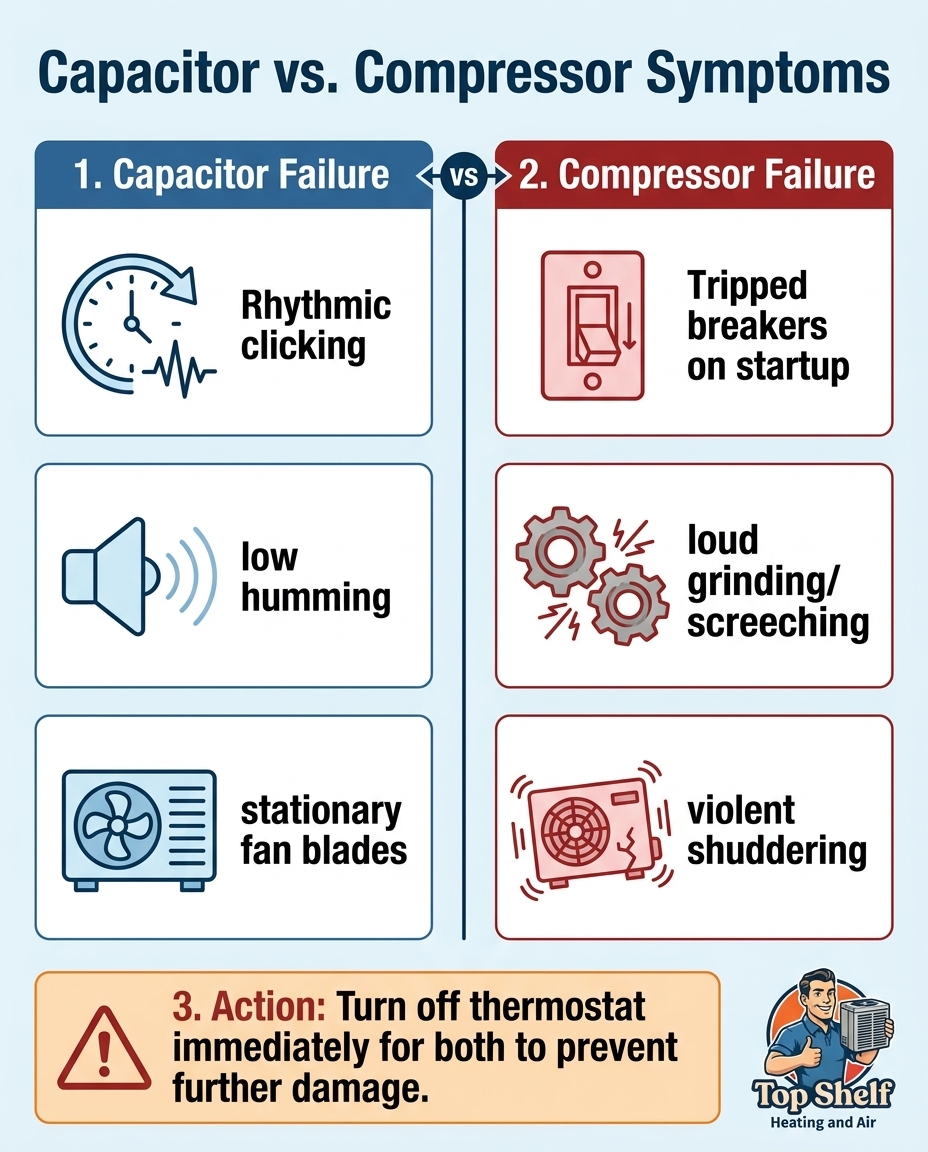
While a capacitor issue is characterized by clicking, humming, and a stationary fan, a true compressor failure often presents much more violent or definitive symptoms. If the compressor has mechanically seized or shorted out, you will typically see different warning signs.
• System Startup Sounds — Likely Capacitor Failure: Repetitive clicking or low humming. — Likely Compressor Failure: Loud grinding, screeching, or violent shuddering.
• Electrical Breaker Behavior — Likely Capacitor Failure: Breaker usually remains on, though it can occasionally trip. — Likely Compressor Failure: Breaker trips instantly the moment the system tries to turn on.
• Fan Blade Movement — Likely Capacitor Failure: Fan is stationary but spins freely if manually pushed by a tech. — Likely Compressor Failure: Fan may still run normally while the compressor remains dead.
• Airflow Temperature — Likely Capacitor Failure: Warm air blowing from indoor vents. — Likely Compressor Failure: Warm air blowing from indoor vents.
If your system trips the electrical breaker immediately upon startup, or if you hear loud grinding noises that sound like metal scraping on metal, turn the thermostat off immediately. These are signs of severe mechanical distress. Ultimately, professional diagnostics are required to definitively rule out compressor damage. A technician will use a multimeter to measure the electrical resistance across the compressor's terminals to confirm its health. If you are experiencing any of these symptoms, relying on professional AC service is the only way to accurately assess the damage.
Why AC Capacitor Replacement in Moorpark CA Requires a Professional
When a homeowner identifies a clicking sound and fan failure, the temptation to search for a quick DIY fix is strong. However, dealing with air conditioning electrical components is not like changing a lightbulb. Capacitors store lethal amounts of high-voltage electricity, even when the main power to the unit is completely disconnected at the breaker panel. Touching the wrong terminals can result in a severe electrical shock. This is why handling an ac capacitor replacement moorpark ca safely requires a licensed professional.
The Danger of Incorrect Microfarad Ratings
Beyond the immediate physical danger of high voltage, there is a significant risk to your equipment. Capacitors are rated in microfarads (µF), which measures their ability to store an electrical charge. Every fan motor and compressor requires a very specific microfarad rating to operate correctly. If you install a replacement part with a rating that is too high or too low, you will alter the electrical current flowing to the motors.
Running a motor with the wrong microfarad rating creates an unbalanced magnetic field inside the motor itself. This causes the motor to run hotter and pull more amperage than it was designed to handle. Over a short period of time, this excess heat will burn through the insulation on the motor windings, permanently destroying the fan motor or the compressor. What could have been a simple, inexpensive repair quickly turns into a massive system replacement.
Comprehensive Electrical Testing
An expert will not only replace the failed part but also test the entire electrical system. When a component blows, it often causes a ripple effect. A technician will test the voltage and amperage to ensure no other components were damaged during the failure. They will inspect the contactor for pitting or burn marks caused by electrical arcing, and they will verify that the compressor is pulling the correct amount of power.
Having a professional handle the repair ensures that the root cause of the failure is addressed. Sometimes, a capacitor blows simply due to age and Moorpark, CA heat. Other times, it blows because a failing fan motor is pulling too much power and overworking the electrical system. A comprehensive check prevents you from replacing a part only to have it blow again a week later. Investing in a preventative AC tune-up helps catch these electrical imbalances before they lead to total system failure.
Frequently Asked Questions About AC Capacitor Failures
What does a blown AC capacitor sound like?
A blown AC capacitor typically sounds like a repetitive clicking or a low, strained humming coming from your outdoor unit. The clicking is the electrical contactor trying to engage the system, while the humming is the sound of electricity reaching the motor without the necessary power to make it spin. You will often hear these noises accompanied by a completely stationary outdoor fan.
Can I run my AC with a bad capacitor?
Absolutely not. Running the system with a failed capacitor forces the motor to try and pull excessive amperage to start itself. This creates immense heat inside the motor windings and can overheat and permanently destroy the compressor or the fan motor. If you suspect a failure, turn the thermostat to the "off" position immediately to protect your equipment.
How do I know if my AC compressor or capacitor is bad?
Capacitors typically produce a clicking sound and fan failure, where the system hums but nothing moves. Compressor failure often involves far more severe symptoms, such as tripped circuit breakers the moment the system turns on, loud screeching noises, or violent shuddering from the outdoor unit. A professional multimeter test is the only way to confirm exactly which component has failed.
Why is my outside AC unit humming and not turning on?
The humming noise is the sound of high-voltage electricity reaching the motor, but the motor is unable to turn. Without the capacitor's stored energy to provide a massive boost of starting torque, the motor becomes "locked" in place. It will continue to hum and pull electricity until it eventually overheats and triggers an internal thermal overload switch.
How long does a typical AC capacitor last in extreme heat?
While these components are designed to last several years, constant exposure to 100-degree temperatures significantly accelerates their wear and tear. The lack of preventative maintenance, such as running the system with dirty condenser coils, forces the component to work much harder and run much hotter. In extreme climates, it is common for these parts to require replacement every three to five years due to thermal stress.
Restore Your Home's Cooling Fast with Local Expertise
A clicking outdoor unit and a sudden loss of cold air on a 100-degree day is a stressful experience, but it is usually a cry for help rather than a death sentence for your entire system. Recognizing the sensory clues—like a clicking sound and a motionless fan—gives you a head start on understanding the problem. The most important step you can take is to act quickly and shut the system down to avoid secondary damage to your expensive compressor.
When the temperature spikes, you need a team that understands the urgency of the situation. Top Shelf Heating and Air provides reliable, rapid-response diagnostics during peak summer heat waves to ensure residents aren't left stranded in dangerous temperatures. Our technicians carry the exact diagnostic tools and replacement parts needed to get your system back online safely. Schedule an inspection today to restore your home's cooling and secure your comfort for the rest of the summer.
Customer Testimonials


Blogs